 Lepere, Refiloe. 2024. “Combat Breathing Mixtape: A Meditation, Lament, and Performance.” Global Performance Studies 7 (2). https://doi.org/10.33303/gpsv7n2a164
A symphony of existence, a journey into the divine. A sonic experience. A mixtape. The mixtape, conceived as a sonic canvas, aims to delve into the intricate connections between belief, breath, and resilience through a curated blend of diverse music, poetry, and soundscapes.
The exploration centres on understanding the contours of breath, of mourning. This exploration unfolds through a dynamic and immersive 15-minute mixtape. In “Combat Breathing Mixtape,” we embark on an exploration asking a fundamental question: “What do you believe in that keeps you breathing?” Through the medium of a mixtape, this project blends personal narrative with intellectual and artistic inquiry. The mixtape is a collection, a conversation. Here, song is storytelling, and a strategy used to understand, perform, and rework trauma stories via the breath. In South Africa, song, like storytelling, is a process of call and response, in order to link emotion with reason and as such situates knowing, within the context of the relationship with the larger community. This is a form of storytelling that combats our current modes of truth and justice. For this paper, performance is an analytic tool used to read songs as examples that provide the occasion for questioning, the possibilities of problematising the dominant discourse and understanding an aesthetic of women’s creative labours.
The reason for the mixtape is because there is something wondrous about a mixtape, where someone has thought of you so deeply they create or collect as it may. The mixtape speaks to a way of storying and thinking about people and loved ones. In her work on trauma, Cathy Carruth (1996) asserts that literature, the arts in a sense, can express a traumatic experience. There are limits to the spoken words, concerning our fragments. However, the metaphoric captures the fragments. The experience lies figuratively in the gaps in speech. What for us captures these gaps and sighs is sound, song and music. This mixtape: though short, is a curation of what I have been thinking through. The mixtape as a creative metaphor allows one to look at how songs and sounds are creative practices that capture a collective trauma; they are also a part of everyday world-making. I want to suggest that this world-making translates personal experiences into aesthetics of resistance. Here, I consider the song as breath. This breath is collective, it is analytic, and it echoes a revolt. The lyrics and poems are used to interrogate our collective world-making practices in the face of oppression. This performance presentation serves as a meditation and lamentation on loss. Grounded in Fanon’s concept of combat breathing, the “muscular contraction” of the colonised body (Fanon [1961] 2004, 157), we, the living, explore the embodied experience of the one who is perpetually on guard. The presentation seeks to understand the contours, the breath and breath of mourning, both as an individual and collective experience, in relation to the wake, politics, and creative practices. Central to the inquiry is the examination of mourning’s role as a performative act of combat or revolt.
The mixtape is an auditory experience that delves into the essence of combat breathing— unlooping the interplay between belief systems and the act of breathing, and exploring the multifaceted dimensions of what keeps individuals resilient in the face of challenges. The mixtape format provides a dynamic and immersive platform that encourages contemplation on mourning, politics, and creative practices. This mixtape contributes to a broader conversation about the intersections of art, belief, and resilience, inviting audiences to embark on a sonic journey that goes beyond the confines of typical academic discourse.
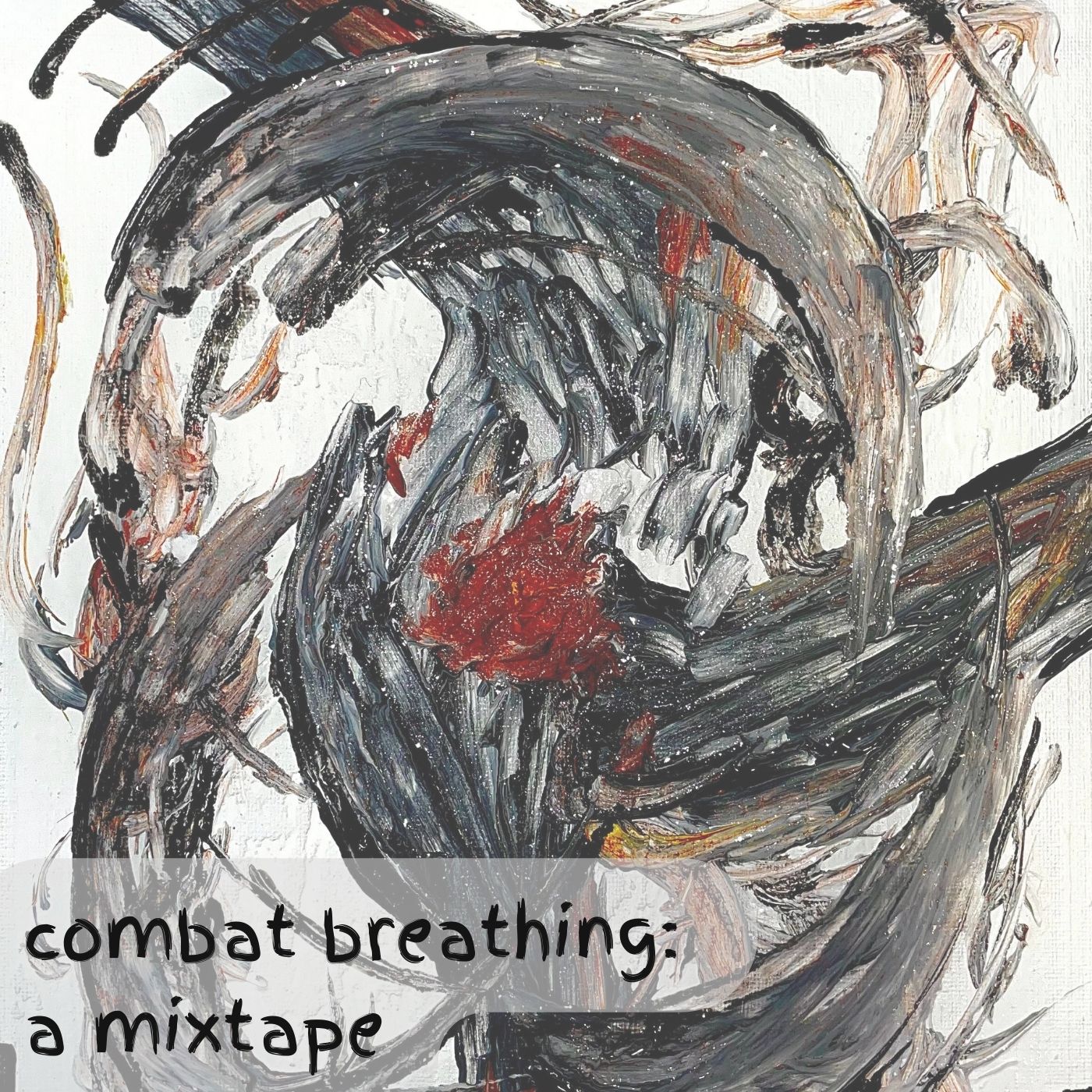
Artwork by Nkululeko Ezra Selulu | Listen on Bandcamp | Subscribe on Apple Podcasts | Subscribe manually via RSS
|
Moment |
Script |
Track |
|
Opening |
What is the weather?
Christina Sharpe (2016, 104) writes that the weather “weather is the totality of our environments; the weather is the total climate; and that climate is anti-black the weather, is death, disaster, and possibility. They are some of the impossible possibilities faced by those Black people.” |
Sound of rain |
|
How to breathe |
How to breathe
Ingredients:
Instructions:
Prepare the breath:
Unmask the face:
Work/Create:
Remember, converse with your shadows:
Learn new rituals:
Listen and engage:
Creativity in action:
Grieve and Heal:
|
|
|
Poem |
We the living
We the living gather to meditate on death— locking eyes over coffins, coffees, and tight-lipped smiles. Empty pockets, lost jobs, wearing ill-fitting suits. Paying bills, We the living wonder, what does it mean to be safe …. What does that mean for safety in a cold front, a heat wave? And what does it mean for the financial health of utilities?
Taking great-looking photos, we the living are tense and poised, shaken, breathing… “Isn’t it strange how life goes on?” We check our phones, have webinars, bake bread, make love, make babies.
In the wake of it all, breathlessness lingers, a constant reminder of our precarious existence. We navigate through the weight of each moment, grappling with the duality of life and death, finding resilience in the rhythm of our breath.
In this wake, we confront our being, our struggle, our strength, breathing in the tension, breathing out the pain. We the living, caught in the delicate dance of surviving and thriving, realise the profound truth: life, despite everything, goes on. |
Sound of cups and saucers |
|
Combat Breathing |
What do you believe in that keeps you breathing?[1]
Playwright Ntozake Shange (1984, 22) repurposes Frantz Fanon’s term “combat breathing,” defining it as “the living response, the drive to reconcile the irreconcilable, the Black and white of what we live and where.” She brings this concept into the performance space, illustrating combat breathing as a manifestation of state violence. This oppressive force leaves colonised individuals feeling breathless, a perpetual condition resulting from systemic violence. As Maldonado-Torres (2016) explains, this breathlessness is an ongoing state for those subjected to such brutality. Writing about decoloniality in South Africa, Maldonado-Torres highlights that youth are not seen as the future but as targets for suppression, incarceration, and ultimately suffocation, symbolising a deliberate attempt to extinguish their vitality.
In Black Skin, White Masks, Fanon ([1952] 1961) writes, “We revolt because we can’t breathe… quite simply… because it became impossible… to breathe, in more than one sense of the word.”[2] Breath, therefore, becomes a tool of resistance, revealing historical and contemporary complexities for conscientisation, critiquing social disparities, and enabling self-exploration. This theatre-making/aesthetic process intersects art, activism, and social relevance, viewing theatre as an instrument of real change.
Combat Breathing, as a Black performance project, is a creative conversation of story, breath, sound, and silence. It makes a claim that this form of Black feminist creative making has significant methodological implications for trauma research. Breath is not only a medium for creative practices that capture collective trauma but is also a part of everyday world-making. This world-making translates personal experiences into aesthetics of resistance.
In this walking audio, I delve into the embodied experience described by as the “muscular contraction” of the colonised body, which is “constantly on his guard” ((Fanon [1961] 2004, 157, 16). I examine mourning in general and collective mourning in particular, to explore the relationship between mourning, wake politics, and creative practices. I investigate how mourning functions as a performance of combat or revolt, using performance as an analytical tool to interpret songs that serve as opportunities to question the possibilities of mourning the unknown or the unidentifiable, and to explore ways of engaging in radical wakefulness.
In this context, I consider laughter as a form of breath. This collective breath is analytical, echoing a revolt. The lyrics and poems used in performances interrogate our collective world-making practices in the face of oppression. Combat Breathing as it relates to songs and collective creative making, including creative mourning, represents a powerful form of resistance. It encapsulates the essence of Black feminist creative practice, intertwining personal and collective narratives to challenge and resist systemic violence and oppression.
Fanon describes the colonised body’s dreams as “muscular dreams: dreams of action, dreams of aggressive vitality. I dream I am jumping, swimming, running, and climbing. I dream I burst out laughing, I am leaping across a river and chased by a pack of cars that never catches up with me” (Fanon [1961] 2004, 44).
This embodies the experience of Black feminist breathing as a form of radical presence amidst multiple forms of violence. It reflects on practices, beliefs, and ongoing conversations about decoloniality, racial prejudice, and social justice, and explores how we can bring anti-bias values to life. |
Horn/trumpet Walking Running |
|
Mourning |
Breathing While Black
Close your eyes if you are safe Breathing while black is neither misery nor melancholy per se, but the way anything buried aspires.
Take a deep breath in through your nose, There blackness wades in like a bladed pendulum swaying between man, and not
Fill your lungs completely. There blackness dips, sits into the position of the unthought, then out.
Focus on expanding your abdomen and chest as you inhale. The space between a plea & please. A father weeping for his life A mother marching A son dead A daughter in anguish
Exhale despair slow breath Exhale forcefully and audibly through your mouth, We are dying here Passing by as the beloved’s memory
We are dying here A dying people, living in most populated, living in structural racism, living in policing, living in hospitals, not working, living in race, living…, the gasping for anger
|
Deep breathing sound |
|
Monologue: The Leak[3] |
Monologue: The Leak (laughter)
WOMAN: Nothing says things fall apart like a leak. It starts with a trickle, a flop, or a blob sound.
When lockdown began on the 15th of March—the Ides of March. A day that’s always been a celebration for me, yet also a harbinger of doom. The soothsayer whispers to Julius Caesar, “Beware the Ides of March.” When that day arrived, countries shut down, airports shut down, air spaces shut down, flights nowhere in, out, soldiers walking everywhere, homes locked in.
I remember waking up to the pipes in the house hammering and clanking violently. I wondered if this is what happens when the plumbing is strong. But with this came an overwhelming feeling of grief and tears I couldn’t control. There was a leak. A literal one; in my body. My eyes just welled up. But there was a literal leak also.. A trickle in the bathroom. A growing map on the ceiling. A brown, dusting wet map. Showing the contours of a years of gathered dust. It grew into a flow. Flop on the floor. Flop! Flop Water running on the tile. Wait that pipe? Did it? Flow. I hear water flow, running outside. Outside the pipe, into the garden. The water flows.
It started as a trickle, then water gushed from the pipes of the house. At first, I thought it was raining. It started as a patter, splashing, small streams, a sudden rush of water from a heavy rain. It sounded like rain.
But our geyser burst, and it felt like a foretelling—an overwhelming experience of grief, loss, and hopelessness. As I sit here, waiting for the announcement of death, I fight to live. Each moment, each breath, a battle against the weight of this sorrow. The leak… it’s like my heart, starting with a trickle of pain, growing into a torrent of grief. I’m holding back the storm, clanking at every moment fighting for every precious second, even as the world around me crumbles.
|
Drips |
[1] This section is not a verbatim transcription of the audio but a reflective re-engagement with it. It is a writing back from the audio, shaped by the rhythms and resonances of the original conversation. While the ideas and analysis remain consistent, this version moves through a more considered narrative form. I encourage the reader to first experience the audio as an intimate act of storytelling and listening, allowing the sounds, pauses, and breath to set the tone, before engaging with this textual iteration.
[2] This is a widely circulating reinterpretation of Fanon’s quote. The actual passage from Fanon is: “It is not because the Indo-Chinese bas discovered a culture of his own that he is in revolt. It is because ‘quite simply’ it was, in more than one way, becoming impossible for him to breathe” (Fanon [1952] 1961, 228).
[3] See note 1.
Caruth, Cathy. 1996. Unclaimed Experience: Trauma, Narrative, and History. The Johns Hopkins University Press.
Fanon, Frantz. (1952) 1961. Black Skin, White Masks. Translated by Charles Lam Markmann. Grove.
Fanon, Frantz. (1959) 1970. A Dying Colonialism. Translated by Haakon Chevalier. Pelican.
Fanon, Frantz. (1961) 2004. The Wretched of the Earth. Translated by Richard Philcox. Grove.
Maldonado-Torres, Nelson. 2016. “Outline of ten theses on coloniality and decoloniality.” Fondation Frantz Fanon. https://fondation-frantzfanon.com/outline-of-ten-theses-on-coloniality-and-decoloniality/
Shange, Ntozake. 1984. See No Evil: Prefaces, Essays & Accounts, 1976–1983. Momo’s.
Sharpe, Christina. 2016. In the Wake: On Blackness and Being. Duke University Press.