 Malcomess, Bettina, and Myer Taub. 2024. “Dirty Walks.” Global Performance Studies 7 (2). https://doi.org/10.33303/gpsv7n2a163
1. Intrductions: DIRTY DITHERING
2. Filming in the THEATRE as re-FRAMing
3. Discord: collection points for a walk without a destination
4. Argument: the timetravellers dream of the city through walking as …
5. REFLECTION: DIRTY DOUBT / RESPONSE DIRTY DOUBTER
6. Proposal for PSI
7. Speculative Groundings: archive as assemblage as deposit across space zones
8. CONSCLUSION
Note to reader: the mis-spellings, spatial layout and changing of fonts in this text is intentional.
The invitation to the reader is to move between this text as a ‘site’ and a Dirty Walks Discord (sic) server as a satellite site, or anti/ante-’text’. This dis-orientation of the act of reading reflects the complexity of an attempt to walk a city in crisis into being, an ecology of ruptures and fragmentation of the enmeshment of the natural borders and the human-made world, of failing infrastructure as metaphor and fact. This multi-scalar and multi-modal journal entry attempts to embody this fragmentation and invite thinking within the movement and crisis.
Furthermore, due to the disobedient nature of the manuscript, the authors recognize how the reader might have preempted expectations and thus their position of reading with resistance to what lies ahead is an embodiment of philosophies of decolonial performative writing. The audio and video submissions inserted within the text contribute to these philosophies encoded as an experimentation of digital walking, as does the Discord server. Intentionally dyslexic, the text drifts between argument and conversation, across scales and formats.
A filmed conversation set in a theatre in Johannesburg forms the backdrop of this text, and is located on the Discord server and embedded as a vimeo link, to be viewed as a whole or in fragments, as the reader wishes. This conversation contains a further backdrop, projected onto a screen at the back of the stage with footage of a walk searching for water in Johannesburg in 2022. Here, in the site of this text and the non-linear accumulations of posts on the Discord server, a series of timelines of different walks converge: some discursive, some digital, some embodied.
abstract dirty dithering. In preparing notes for the draft of this abstract, as a draft of required reflection of now–of a more substantial chronological reflection called DIRTY WALKS as Dialogue Between Action and Aecedia[1] that attempts IN describing how retracing chronological transmissions of COLLBORATIVE EXCHANGES IN WAlKING PRACTICE are not only just that - dialectics in practice - but also like an undercover hauntology - retracing past conversations made between action and aecedia. This is a way of reconciling considerable time experimenting with forms in the walking praxis / the praxis of walking with and during crisis; WE as the authors suddenly realize WE ARE suffering from Aecedia. (Well I did -
“Aecidia
The definition of aecidia is the fruit of a rust fungus. A playful ecological misnomer made from suffering…. WE ARE suffering from Aecedia. WE Are suffering from Acedia as a combination of inertia and grief.
Walking as praxis is an example of such immediacy and in Retracing their steps, the authors share their encounters with this mode of transport and research by how it has also informed experimentation with evolving performance as research methodology. Part of this is the continued maxim in this kind of research to the performing of ideas, like this paper that is performative so that its operation is to illicit a mode of reflexivity, shifting between tenses and time that takes its pulse from what it is to be different (Pollock 1998, 82). It is also dyslexic, perofming the literal ‘dys’ or ‘dis’ (as in the latinate root for difficulty) of speech (lexis), or of translating speech into written -------. Before its coinage in 1977, Dyslexia is originally called: wortblindheit (word blindness) (Kirby 2018).
The suggestion of suffering is made because of - crisis and how living in this time of crisis is a performative measure made from acts of resilience and melancholy. The time of crisis is contemporary (2001–2022; see Negri 2003) and we want to suggest ways of contested/resilience-re-making and remembering through tracing redemptive technologies about knowing in the unknowing or unlearning as an intersectional theme, along with glitches and fissures and dislocations and immediacy made in crisis.
The crisis is both political and ecological and has produced an entire literature of crisis, and a literature theorising or grappling with the anthropocene. Donna Haraway’s book Staying with the Trouble: Making Kin in the Cluthulucene (2016) problematises this term, along with various writers who address the way that its omissions continue to reinforce a human-centered rhetoric and offer no new thinking about the environment. For example, Kathryn Yussof’s scathing critique of geological knowledge, A Billion Black Anthropocenes or None (2018), working through Black critical theorists, such as Kathryn McKittrick’s Demonic Grounds (2006) , makes clear that geological time stamps and golden sections that mark the start of the anthropocene with the arrival of steam power, or the marks left in rock surfaces of the first nuclear testing in New Mexico, still commit the same crimes in excluding the racial constitution of the anthropocene. Basically, Yussof argues that geology allowed the very identifications of properties of rock to prepare for its extraction as stone: precious, precarious, and now property. And so paved the way for the extraction of humans, or those considered the property of the Western European Enlightenment version of the human.
Haraway runs through various messier options to name the ecological crisis: instead of capitaloscene, she settles on Cluthulucene, named as such after the tentacular and the ‘monstrous’ embodied by the spider and the octopus (Haraway 2016, 15–20). This monstrous, tentacular present speaks of the city where our walking praxis is located, a city whose image remains elusive, multiple, oriented to its future - never accounting for its past violent extraction of Black labour and the gold along the plundered and exposed reef that runs from east to west along the spine of its sprawling motorways. This city contains a disrupted nature, and an artificial forest, tentacular in all ways: trees and invasives multiply it’s green, shade its gardens and pedestrians, and conduct its lightning.
Our walking began at the moment of lockdown, evolving from and within the Covid 19 crisis, a beginning embodied in the empty city, the city without traffic, the city of overgrowth and unmowed verges, where nature’s tentacles explode the pavements. Later, as the economic crisis that followed the pandemic set in, we began to see on our walks the splits in the road as the water escaped the aging municipal piping, and the neglect (aecadia) of infrastructures spread from poorer neighbourhoods on the urban edges, such as Yeoville, to the wealthier suburbs, such as Houghton.
I followed this departure when I moved from Yeoville to Houghton.
This altered the routes of the walks,
and relocated the studio from Bez Valley to Grant Avenue.
Things looked different from the other side.
Now prompted by reflection on how to measure this, and to hold its yearnings and desires is also to set up on the writing composition of dialogue and experimentation of dialogue with walking, promoting a conversation, a dialectic between Aestecic and Action: meetings , intimate conversations made with ourselves—the authors—in the process of wakling as a creative praxis and the co-productions of the self and iii.) our considerations about making—with the other—through excavating from research as a construct of performance ideas. the following is presented.
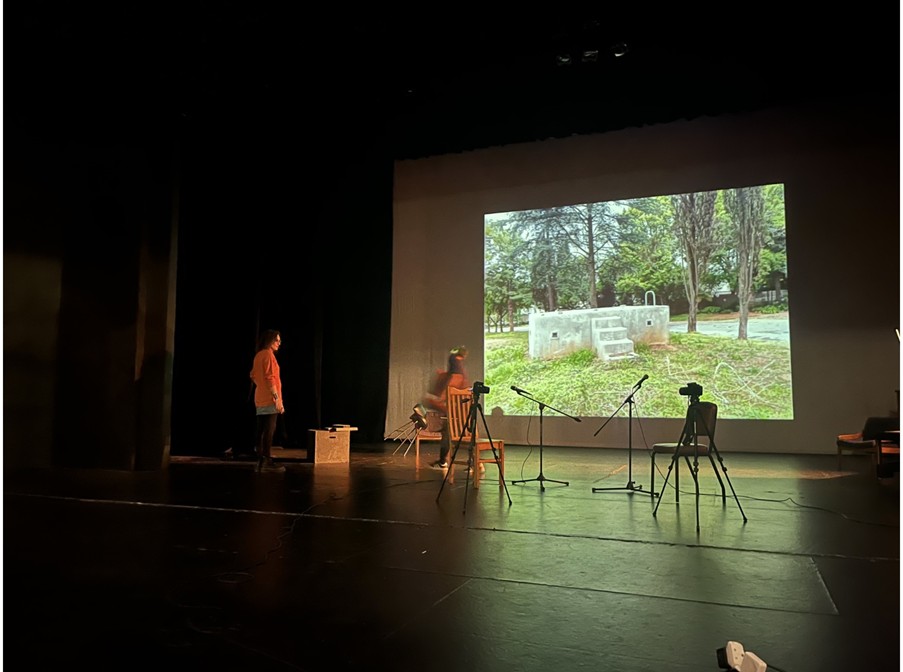
Figure 1: Wits Theatre: staging the conversation
Here, the conversation unfolded around a series of questions posed by an interviewer, Bayyiha, who sat in the auditorium, while we were positioned on stage. Between themes and prompts, our chairs were swapped with other chairs by a stagehand, Zeno, while lights were dimmed or repositioned ... on cues from the director, David Wein. Projected behind us was footage of our latest dirty walk, the water walk, where we had been led along a route familiar to both of us. First to visit Myer’s mother at the Jewish old age home in Senderwood, and second following a route to Bettina’s childhood home, the house of her grandparents in Bedfordview. This was in fact the second house. They never made it to the first.
Being directed in this way to reflect on the walks, on dirt and failing infrastructure, on urban ecologies in a time of crisis and collapse, placed us just enough outside of our own embodied practice to understand this as a methodology searching for a language by which to address the city. This language is not necessarily written, or spoken or theoretical, but a series of gstures, gestures, tooled gestures that open portals.
Questions:
When did you start walking?
Does this relate to your book, Not No Place?
Myer, can you tell the story of where you were when 9-11 happened?
Do you think this is a practice that is inherently situated in and thus emerges from growing up in Johannesburg?
How does your whiteness define your mo/vement through the city?
What about being queer?
Is the stage the mis-en-scene for the walk? Or does the city become the stage for the walker? Does it matter who is walking?
***************************************************************************
Action: I want to write on methodologies on Action, on aescetics.
Aecidia: No you don’t, go on, do something else.
Action: “More on Michael Taussig on the Walter Benjamin quote on Aecidia… More to follow….” then Myer transforms into Action becomes Aecidia and Betina - contnue to talk elsewhere
***************************************************************************
Erica Carter (2023) writes about walking to the cinema “as understood as akin to a fluid establishing shot in which the spectator’s peripatetic body prefigures the work of the camera in film, becoming a recording instrument mobilised to establish the space-time of the film experience already in the very act of going to the show” (28–29)
we literally walk the city into being. In Not No Place: Johannesburg, Fragments of Spaces and Times, I wrote a time traveller character, which is a loose analogy for my own positionality as a white and queer body out of place as pedestrian in a city where race, class privelege and gender overdetermine public space, and whose name is ‘Jack’, thus a figure of gender ambiguity. Jack walks the city to collect data, to understand a city where the law of entropy had been broken, in ways that I as a privileged, middle class white and queer subject cannot move as freely on foot in a city where I largely drive.
Acedia plays an important role in the literary criticism of Walter Benjamin. In his study of baroque literature, The Origin of German Tragic Drama, Benjamin describes acedia as a moral failing, an ‘indolence of the heart’ that ruins great men. (Wikipedia 2025)
Myer: Modality has a connection to architecture. This is the comprehension of what already seems visible, ‘the image understood as dialectic at a standstill is transformed into writing…’ (Weigel 1996, 52). It is also a meditative practice for thinking in images and deriving thought from images, suggesting how thought and image stimulate each other and assist in solving problems. For ideas can be constructed into images and images can operate as ideas.[2]
Bettina: But this brings us to the problem of infrastructure and ecology. How do we separate the two in a city of leaks, and natural gas explosions in sewage tunnels? Nevermind architecture. What is a city that is collapsing, a city between natures. A second nature?[3]
The Discord Server and channels function as collection point for a walk without a destination:
https://discord.com/channels/1239499675799916555/1239499676240052315/threads/1249844494317260922
For discord access: dear reader, to access the discord site you will need to create a login, which is quick and free to make. Follow the prompts on discord and enjoy access to our server and many other interesting things! Please feel free to add to the Discord on your own walking as research.
The server is a living space that continues to hold and contain the threads of former and future walks. It is a digital version of the studio drawers of the Joining Room, a platform through which we hosted the walks. It’s Bettina’s studio, and more. Joining Room is a space without infrastructrue, that joins onto another space, whether digital or physical as host, as parasite, to hold practices that are normally seen as separate, in conversation. The studio drawers held the collection from Dirty Walk #1, which was documented by a photographer and artist, Adrian Fortuin, who was doing a residency in the studio at the time. The photographs (a menu from a bar, a newspaper from the day and various ephemera) continue to be held in the drawer. A time capsule and repository. The discord server is also a drawer.
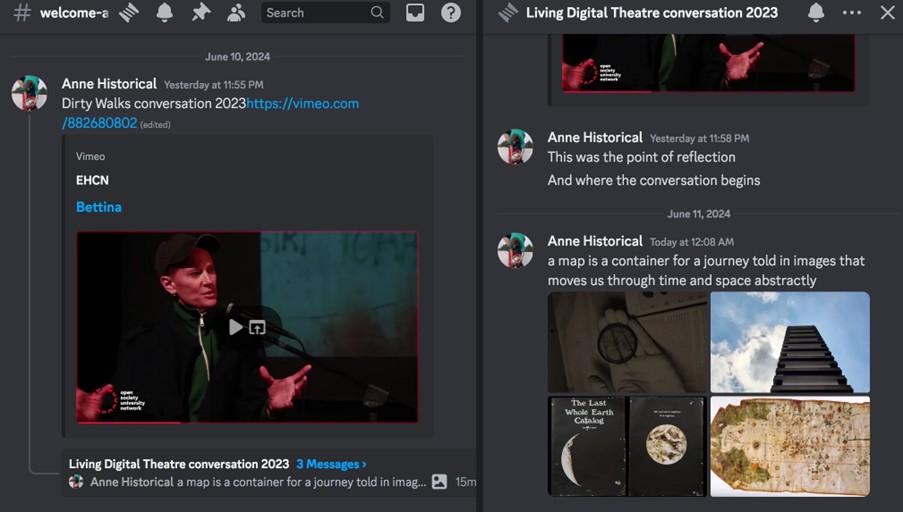
Fig. 2. The Discord stie and its prompts
Benjamin recurs in the translations of the thoughts and images - THE AUTHOrS have always placed his thinking in THIER research as easily captured by an AURA MADE FROM AN IPhone governed by the concept of ‘the translation of the language of things into that of words’ (Weigel 1996, 51).[4] Often WE have used images INTERPLACED from visual arts & THEATRICAL ARTS to provide examples or even direction in reading and composition of theory. ‘Acedia plays an important role in the literary criticism of Walter Benjamin. In his study of baroque literature, The Origin of German Tragic Drama, Benjamin describes acedia as a moral failing, an “indolence of the heart” that ruins great men’ (Wikipedia 2025). Tragedy structures almost all of Western art’s sensibility, organising all aesthetics around the tragic flaw’ (see Payne 2018).
Perhaps collecting is the ultimate tragic gesture for a city that constantly wants to forget itself. A city without nostalgia, where monuments sit mute and unremembered, and the future of speculation and accumulation is communicated in billboards for estate agents and new developments.
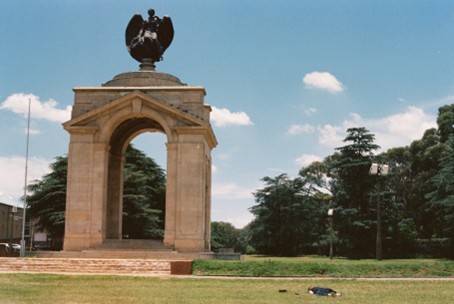
Figure 2: image of the sentimental agent sleeping at the South African War Memorial behind the zoo.
Erica Carter (2023) writes about walking as formative of a subject’s relationship to place, and here specifically, her study is of the role walking plays in shaping white colonial subjectivities, for whom mobility—through certain areas of the city designated for them—is a given. While Carter’s study relates to walking in the British colony of the Bahamas, this idea of passage as given to some, and excluded for others is important to acknowledge in attempting to treat walking as a research methodology. As white and queer subjects, our trajectory through the city is over-determined by race and gender. Middle class, white subjects do not generally walk in Joburg, and so Myer’s choice to walk to work is about exercising an option, or what de Certeau ([1980) 1997) would call a tactic, as opposed to a strategy.[5] Myer’s masculinity and his whiteness as a specific embodiment that refuses the convenience of a personally owned motor car is unusual in Johannesburg for someone in his class position. While the majority of Black joburgers walk to points where they can catch the mini bus taxis that are the only way to navigate the city’s flows, do so not by choice, but by necessity. These city dwellers may in fact consider themselves middle class, so categories of class are not always stable in a society scarred by a history of racial capitalism. Women walking alone to taxi pickup points are, however, incredibly vulnerable, and if I am walking at rush hour, I often see how they check over their shoulders, holding hand bags close and moving quickly. I too am an outsider on this street, being white and queer femme, I occupy a strangely ambiguous positionality, mobilising my androgyny to intentionally trade on a more masculine persona to move through space unnoticed. I am of course seen, and seen as out of place, but left largely alone.
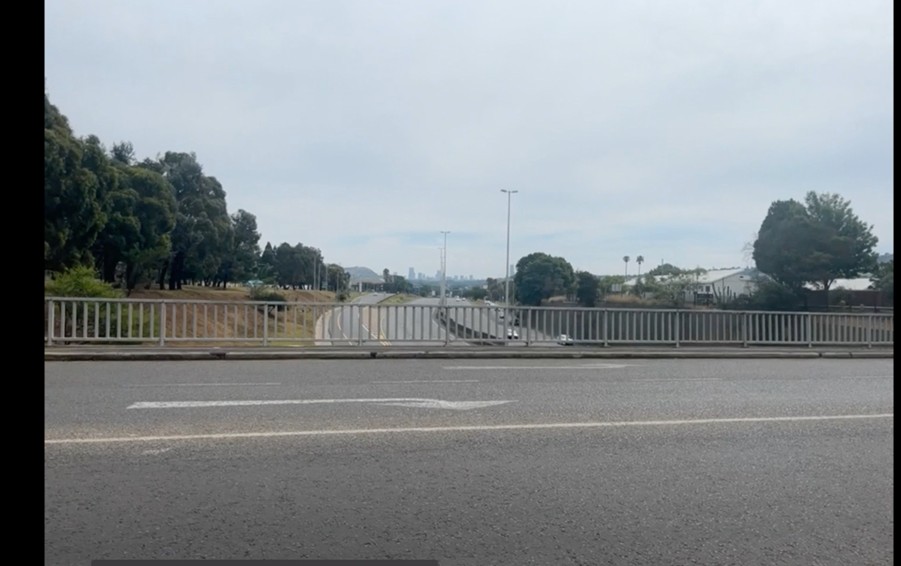
Figure 4: the water walk (crossing)
Carter’s study of racialised and gendered embodiment in white colonial subjects makes some useful suggestions as to how to read our movement through a much more fragmentary post-colonial city like Johannesburg. Through anthropologist Brian Larkin (2013) and sociologist Catherine Fennel (2015), Carter discusses how both infrastructure and mediation create “‘the ambient conditions for everyday life’ […] a way of tuning into the desire and sense of possibility expressed in the very materials of infrastructure’ (Carter 2023, 25). She extends this from infrastructure to media, which in our case would be the smartphone camera that shapes the archive of walking, a document of our mobility. Through Catherine Fennel, Carter describes media and infrastructure as constituting the
‘ambient envelope’ of lived experience: an experiential scaffolding that exceeds the technical functioning of say, media or transportation networks … becoming instead a semiotic, aesthetic and formal assemblage that ‘put[s] bodies in the path of things that hum, radiate, flicker, corrode, and lurch […], sending them careening, changing their relationship to space and time.’ (Carter 2023, 25–26, quoting Fennel 2015)
Walking the city thus em-places us in the ambient envelope of Johannesburg’s multiple temporalities and states of mobility, while it also re-embodies and reminds us of the whiteness and queerness, and the feminine and masculine inscriptions, that over-determine and condition our emplacement within the city. Several theorists of urbanism (such as AbdouMaliq Simone) also see the relational networks of support and communication as a kind of infrastructure, in other words people are also infrastrcuture. Fennel argues that an understanding of infrastructure and media as things that shape the city dweller’s sense of emplacement, especially in environments where infrastructure is breaking down, or is neglected, or where the lines between infrastrcuture and nature are blurred.
Walking the pockmarked tar of Johannesburg and it’s streets flooded with water from burst pipes, a repair by Joburg Water night crews underway beneath an oversized board, marking the territory of an estate agent who manages property sales in the area, where security workers pass in the opposite direction to me on their way to night shifts as I head home from the gym.
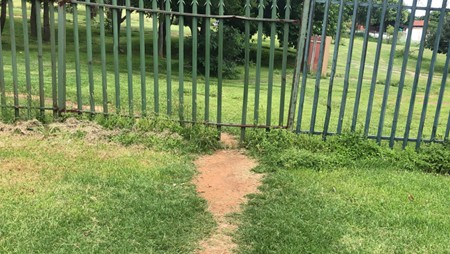
Fig. 5. Water walk: En route to the aquifer.
Oh, I-I-I-I had
The time of my li-I-I-ow
And I’ve never felt this way before-fore
And I swear-wear
This is tru-u-ue
And I owe it all to you-ou
Dirty bit
Dirty bit
Dirty bit…” [O]: `the Black Eyed peas the time (dirty bit) 2007
Dirt, as we know from the famous phrase, is “matter out of place,” a definition that, Mary Douglas states, implies two important conditions: “a set of ordered relations and a contravention of that order” (Douglas [1966] 2003, 44).
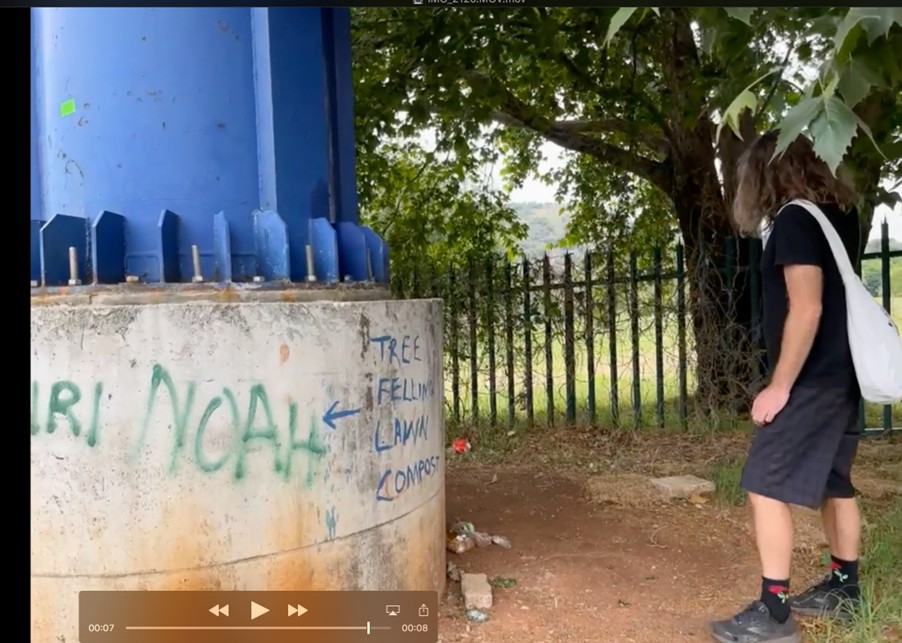
Figure 6: Water Walk: modeling the aquifer (sampling)
In reflection post reflection of the walk of doubt (date) (very recent)
I wrote this of a doubty walk
A point of relfection
About praxis
Praxis as function
Proppellent
Ok enuf centre
Start with a recall of wlaking like a device to go on walk – two weeks back the recall of the exercise dirty walks
And provide structure to the yearning to describe, or even better explain but it becomes different on the plane of transcription when the practice is so – as walking – recovery I gave a claas in graduate researhs eminar program art and Anthropocene I referred to general modes on walking about Prompts Loci Interventions
But not in that order
Here the order contests the propellent, the necessary ecological propellent of walking
Wlaking in crsis
We doubt ourselves
Actiions Alliterations
The only response is to go to discord and back to Dada back to – Front
The Dada walk
The walk of the future
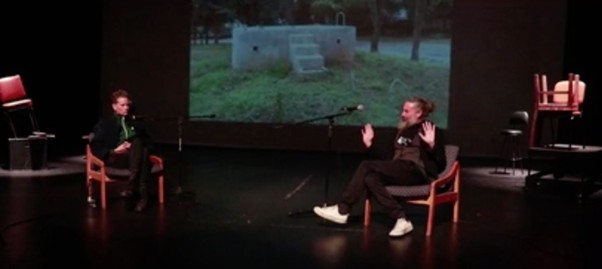
Figure 7: The conversation: projection of the non-monument (future ruins) after Robert Smithson.[6]
MARY DOUGLAS AND WALTER BENJAMIN WALKING TALKING
As much as Benjamin has influenced the cosomenstruction of theory around thought-images, the influence extends through and develops from the rather basic methodology of redeeming fragments from the ruin further as a prompt of PHYSICAL enquiry into this encouraging text of playful depression, and REFLECTION of practice in crisis as modes of playing
The conversation in the theatre: https://vimeo.com/882680802
lost (in transit to Bogotá)
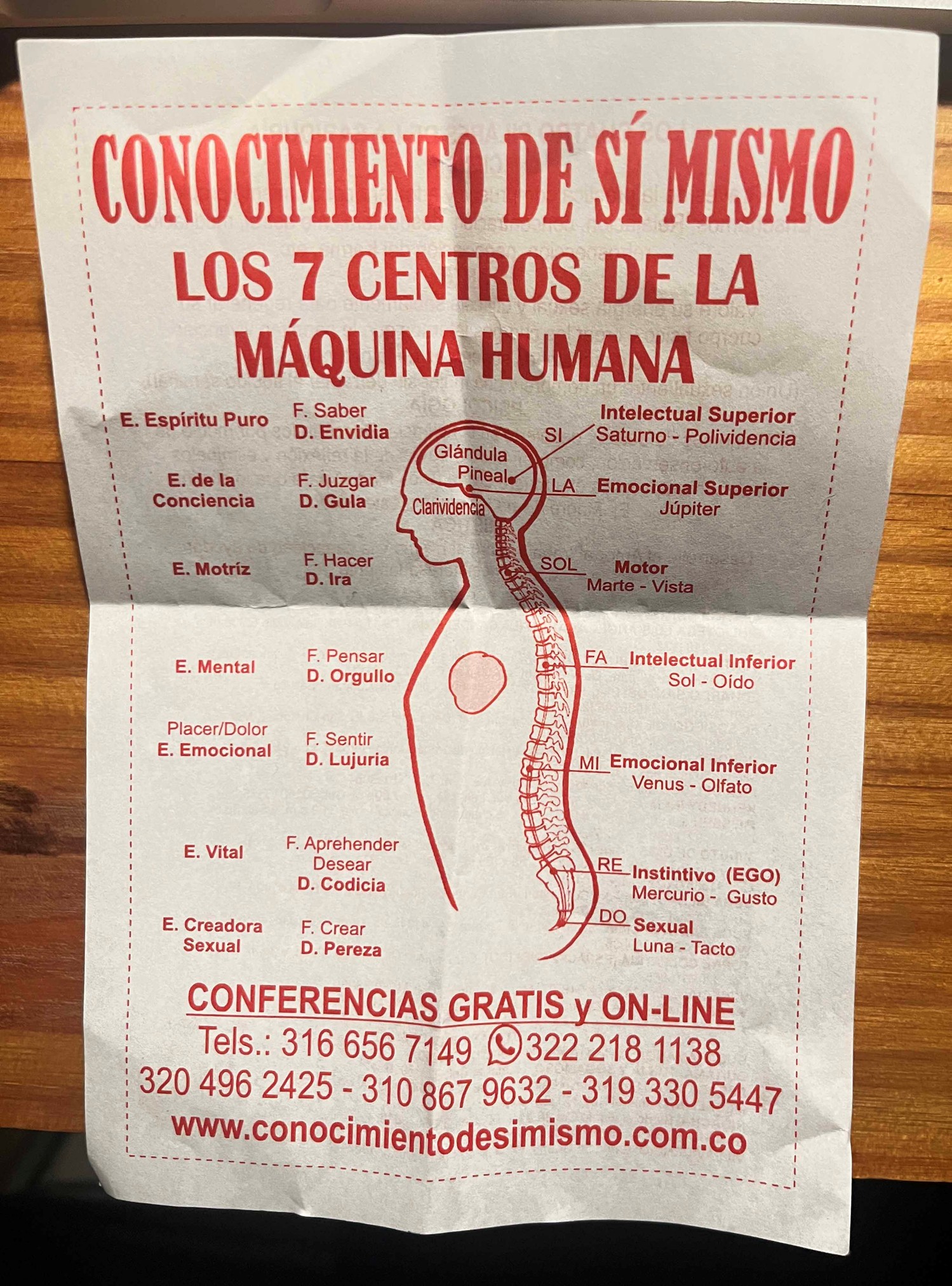
Figure 8: Máqina Humana
I’m sitting in the apartment in Bogotá, writing this last scene for the theatre, or after the theatre. In the conversation on the stage, Myer returns us to a scene that is definitive for the current understanding of crisis: 9-11. Myer was in New York when the World Trade Center was bombed and witnessed the crowds walking away from the site of the rupture. Johannesburg is a city of ruptures, beginning with its first deep level mines and their toxic tailing dams. The description of the scenes of rupture in Myer’s story is profound because it takes us back to de Certeau’s famous ‘Walking in the City’ in The Practice of Everyday Life. De Certeau opens the chapter with this description, that in hindsight becomes an uncanny foreshadowing:
To be lifted to the summit of the World Trade Center is to be lifted out of the city’s grasp. One’s body is no longer clasped by the streets that turn and return it according to an anonymous law, nor is it possessed, whether as player or played, by the rumble of so many differences and by the nervousness of New York traffic. When one goes up there, he leaves behind the mass that carries off and mixes up in itself any identity of authors and spectators. An Icarus flying above the waters … his elevation transfigures him into a voyeur. It transforms the bewitching world by which one was ‘possessed’ into a text that lies before one’s eyes. It allows one to read it, to be a solar Eye […]. (de Certeau [1980] 1984, 92)
It is worth spending some time unpacking this quote. If we follow some of the theatrical and cinematic reframings of walking through Carter and our own restaging of a walk on camera in the theatre, we are left with an image from de Certeau that is more cinematic than theatrical, made possible by the height of the building, or the movement of a camera attached to a plane or a drone. What is interesting is that this ability to read the city is made possible only when elevated above the city, outside of its messiness and what Fennel (2015) calls its ‘ambient envelope’: sound, smell and bodies in motion. For de Certeau, the walker is subject to the ‘Icarian fall’, which is a “fall back into the dark space where crowds move back and forth” (92). The walkers that Myer passed through that day, who walked past him covered in the dust of the collapse, really understood that fall. And this is the rupture that only the walker can embody as a kind of speculative knowledge that travels across times, that is by nature ‘spectral’, hauntological and that leaves a trace both on the ground, and on those who travel with it.
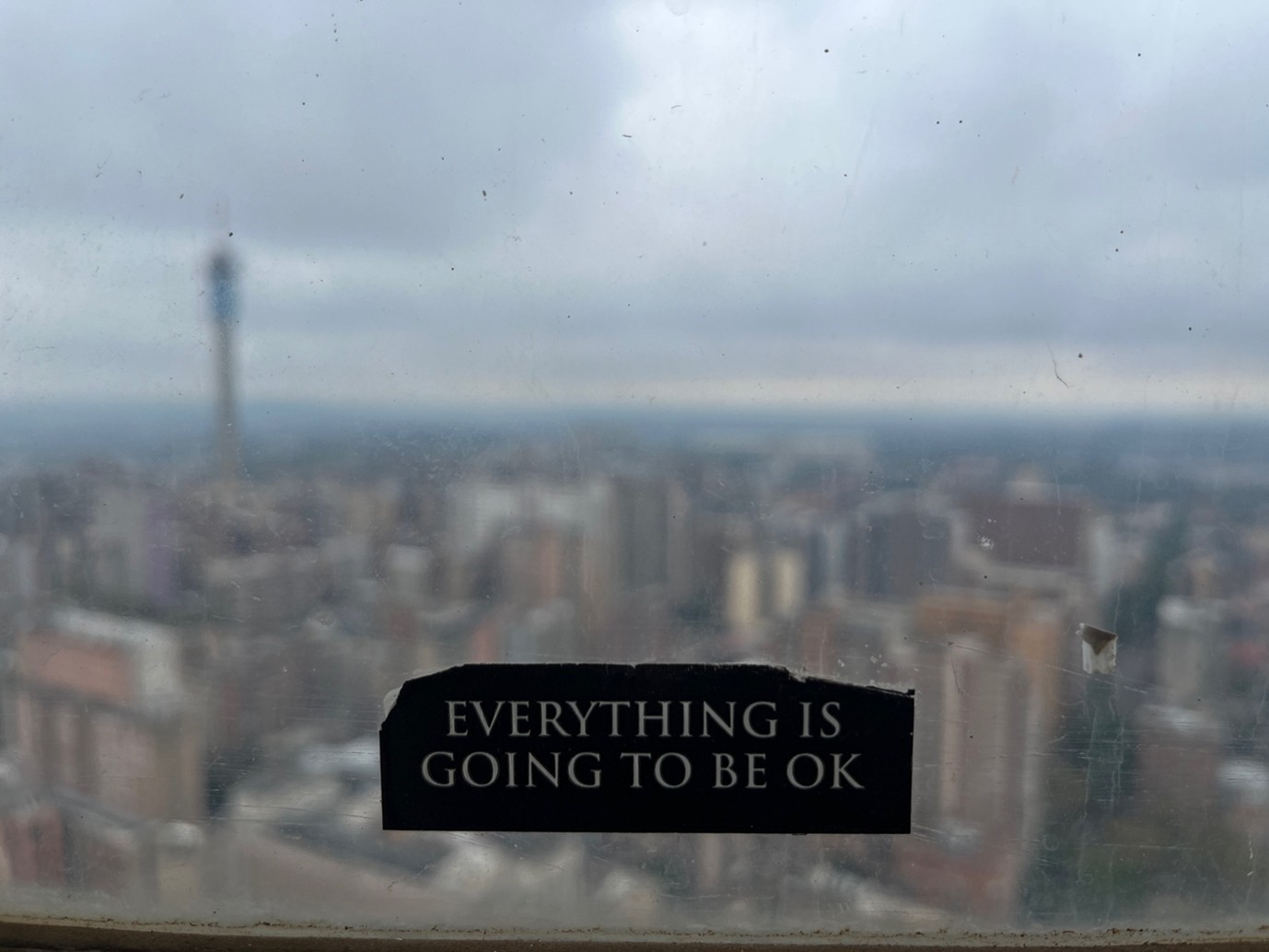
Figure 9: Ponte City view
[1] ‘Acedia (/əˈsiːdiə/; also accidie or accedie /ˈæksɪdi/, from Latin acēdia, and this from Greek ἀκηδία, “negligence”, ἀ- “lack of” -κηδία “care”) has been variously defined as a state of listlessness or torpor, of not caring or not being concerned with one’s position or condition in the world’ (Wikipedia 2025).
[2] Weigel (1996) helps to explain the difference between image and thought-images through these two observations, this is in relation to Benjamin:
i.) Image as likeness, similitude, or resemblance (23).
ii.) The combination between thought and images provides ‘a double sense: as images in relation to which his thoughts and theoretical reflections unfold, and also as images whose representations are translated into figures of thought…’ (51).
[3] The term second nature is attributed to Adorno’s understanding of the displacement of nature with culture, the moment where even gesture, the most constructed and ideological of emotions, actions, and feelings appear natural (Adorno [1932] 2006).
[4] Aura is best defined by Benjamin’s comparison between ‘closeness and ‘distance’. The original object or experience has a distance that cannot be reduced, while the reproduction (digital or analogue) of an object or experience, is infinitely reproducible, and has an infinate potential to circulate, to proliferate. Like Hito Steyerl’s poor image (Steyerl 2009) it is infinitely copy-able. This loss of aura is what Benjamin describes as a loss of distance, the ability to bring things ‘closer’. See Benjamin ([1935] 1970).
[5] De Certeau distinguishes tactics from strategies in a way that is reminicsent of Glissant’s ([1990] 1997) idea of directional versus non-directional nomadism, where the Roman conquerer would have strategy, the errant decolonial figure would have a route determined by tactics embodying fugitivity and opacity.
[6] Robert Smithson’s “The Monuments of Passaic” (1967) recounts his journey back to his hometown in New Jersey by bus and on foot, where he photographs municipal and dam structures that he calls ‘future ruins’.
Adorno, Theodor W. (1966) 1973. Negative Dialectics. Translated by E. B. Ashton. Routledge.
Adorno, Theodor W. (1932) 2006. “The Idea of Natural History.” In Theodor W. Adorno: Things Beyond Resemblance, edited and translated by R. Hullot-Kentor. Columbia University Press.
Benjamin, Walter. (1935) 1970. “The Work of Art in the Age of Mechanical Reproduction.” In Illuminations, edited by Hannah Arendt, translated by Harry Zohn. Schocken.
Carter, Erica, Eileen Rositzka, and Bettina Malcomess. 2023. Mapping the Sensible: Distribution, Inscription, Cinematic Thinking. De Gruyter. https://doi.org/10.1515/9783110769012.
Carter, Erica. 2023. “White Bodies in Motion: Mapping Cinema and Whiteness in the Postwar Bahamas.” In Mapping the Sensible: Distribution, Inscription, Cinematic Thinking, edited by Erica Carter, Eileen Rositzka, and Bettina Malcomess. De Gruyter.
de Certeau, Michel. (1980) 1984. The Practice of Everyday Life. Translated by Steven Rendall. University of California Press.
Douglas, Mary. (1966) 2003. Purity and Danger: An Analysis of Concepts of Pollution and Taboo. Routledge.
Fennell, Catherine. 2015. “Emplacement.” Society for Cultural Anthropology: Theorizing the Contemporary, 24 September. https://culanth.org/fieldsights/emplacement.
Glissant, Édouard. (1990) 1997. Poetics of Relation. Translated by Betsy Wing. University of Michigan Press.
Haraway, Donna J. 2016. Staying with the Trouble: Making Kin in the Chthulucene. Duke University Press.
Kirby, Philip. 2018. “A brief history of dyslexia.” The Psychologist (The British Psychological Society), 8 February 2018. https://www.bps.org.uk/psychologist/brief-history-dyslexia.
Larkin, Brian. 2013. “The Politics and Poetics of Infrastructure.” Annual Review of Anthropology 42: 327–43. https://doi.org/10.1146/annurev-anthro-092412-155522.
Malcomess, Bettina, and Dorothee Kreutzfeldt. 2013. Not No Place: Johannesburg. Fragments of Spaces and Times. Jacana Media.
McKittrick, Katherine. 2006. Demonic Grounds: Black Women and the Cartographies of Struggle. University of Minnesota Press.
Negri, Antonio. 2003. Time for Revolution. Translated by Matteo Mandarini. Continuum.
Payne, Mark. 2018. Hontology: Depressive Anthropology and the Shame of Life. Zero Books.
Pollock, Griselda. 1998. Mary Cassatt: Painter of Modern Women. Thames & Hudson.
Smithson, Robert. 1967. “The Monuments of Passaic.” Artforum 6 (4) (December): 48–51.
Steyerl, Hito. 2009. “In Defense of the Poor Image.” E-Flux Journal, no. 10 (November). https://www.e-flux.com/journal/10/61362/in-defense-of-the-poor-image.
Weigel, Sigrid. 1996. Body-and Image-Space: Re-Reading Walter Benjamin. Translated by Georgina Paul with Rachel McNicholl and Jeremy Gaines. Routledge.
Wikipedia. 2025. “Acedia.” Last modified 12 August 2025. https://en.wikipedia.org/wiki/Acedia.
Yusoff, Kathryn. 2018. A Billion Black Anthropocenes, or None. University of Minnesota Press.