 Nurhidayat, et al. (Abu Dhabi Public Spaces Collective). 2024. “Improvised Access: Listening for African Migrants’ Journeys through an Abu Dhabi Public Park.” Global Performance Studies 7 (2). https://doi.org/10.33303/gpsv7n2a131
Produced and Compiled by Yusril Nurhidayat
Written by Samuel Mark Anderson, Laure Assaf, Cadence Cheah, and Piia Mustamäki
Researched by Cadence Cheah and Yusril Nurhidayat
Additional Materials from Yana Peeva, Joan Ritte, Danutė Vaitekūnaitė, Mandip Subedi, Jahan Farhana, Nasiba Akhmadullaeva, and Lyna Ammagui
Narrated by Yana Peeva
Improvised Access: Listening for African Migrants’ Journeys through an Abu Dhabi Public Park is a sonic manifestation of African migrants in Abu Dhabi renegotiate their place in a segregated economy in search of upward social mobility and agency. The research emerges from the ongoing project “Abu Dhabi’s Public Spaces” sponsored by NYU Abu Dhabi’s Arts and Humanities Division, and explores African migrants’ creative use of an open public space in the city to forge connections, seek opportunities, and ultimately create their own sense of belonging. The soundscape seeks to amplify the tactics of improvisational urbanism that African migrants bring from their home countries while navigating between “productive visibility” and “hypervisibility.” In so doing, their improvised access to the park becomes a gateway to access social and job networks and, ultimately, the city itself.
This project collects student ethnographic research in a soundwalk that relates physical environments with audio clips and images in order to create a “hybrid” spatial experience and offer “an alternative way of creating, representing, and producing meaning in relation to place” (Talianni and Charitos 2013), ultimately offering new approaches to the “representation of space” (Lefebvre [1974] 1991). In a city where the African migrant community operates on the peripheries, a digital soundwalk project provides an avenue to center their voices and make their presence and struggles more resonant with academics, policy makers, and the general public.
Listen on Bandcamp | Subscribe on Apple Podcasts | Subscribe manually via RSS | Download as mp3
Click to visit ArcGIS Storymaps version
Cadence Cheah (CC): “… Can I just ask you how often do you come to the park?”
Akello (AK):[1] “Yeah, always. This is my place where—actually this is a place where I will meet people.”
CC: “Why did you decide to come to the park?”
AK: “Because, this is the only place where we can interact. You know UAE—Abu Dhabi mainly—it’s a busy place, but this is where you can easily identify [others from] your nationality or you can easily talk to another person, like you.”
Sounds from Electra Park/surrounding area
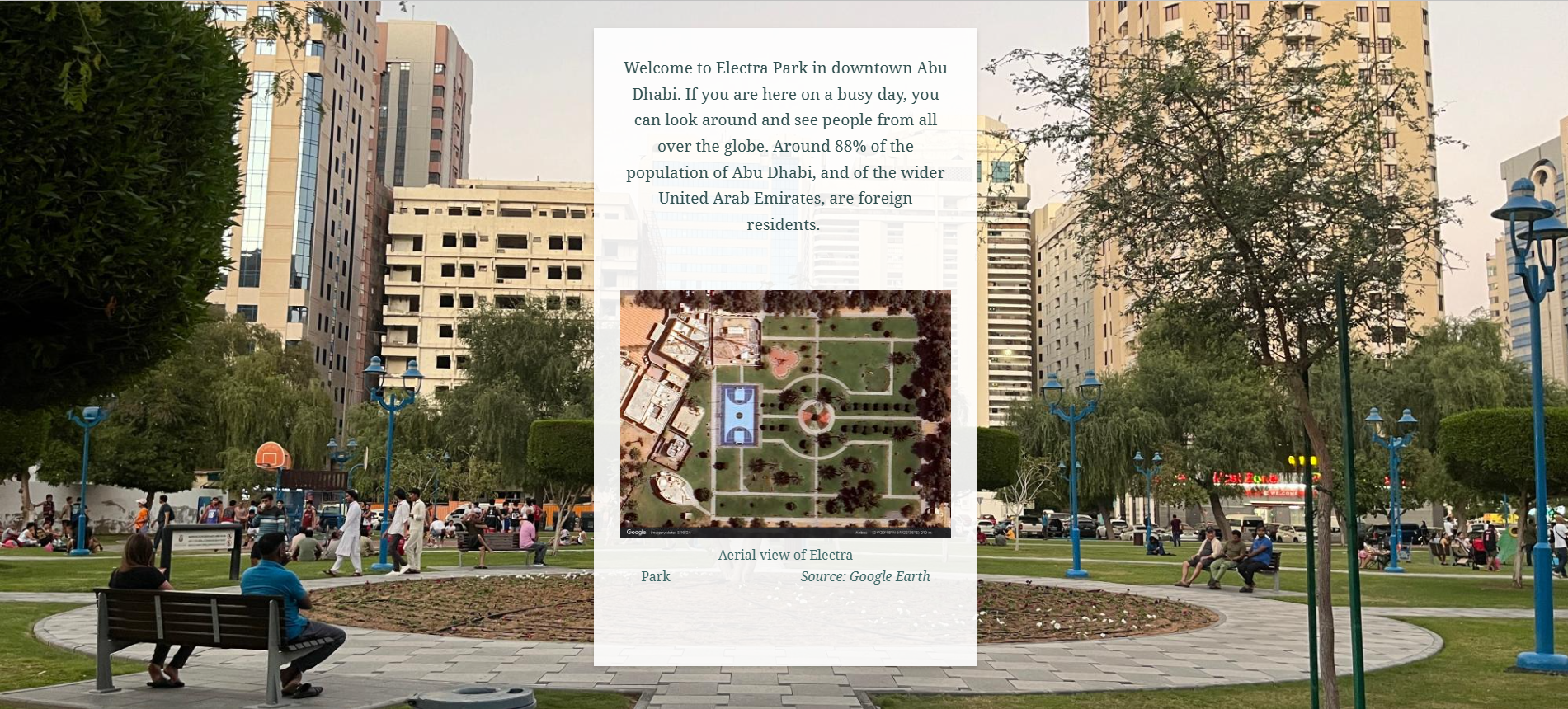
Yana Peeva (YP): Welcome to Electra Park in downtown Abu Dhabi. If you are here on a busy day, you can look around and see people from all over the globe. Around 88% of the population of Abu Dhabi, and of the wider United Arab Emirates, are foreign residents. Electra Park is the nickname of one of the few green spaces in Al Zahiyah, an older immigrant neighborhood downtown. A small open square about 150 meters wide, it sits between a neighborhood mosque, bus stops, small shops, cafeterias, and apartment complexes.
Sounds from the Al-Zahiyah neighborhood surrounding Electra Park
YP: As you can tell from the sounds of traffic and people, Electra Park is open on all sides. This accessibility is not typical; in the UAE and the Gulf in general, many green leisure spaces can only be reached by car, and you need to pay for entry. Even then, access might be restricted to families.[2] These limitations exclude low-income foreign workers, who are mostly men migrating alone.[3] Many scholars have pointed out how spatial segregations are an important feature of Gulf cities: they reflect social hierarchies which crosscut gender, social class, nationality, occupation, and race and ethnicity.[4] Our research team studies these intersections through an ethnographic exploration of Abu Dhabi’s public spaces. I’m Yana, a student assistant who has been working on this project for two years—and you’ll hear from more of us as we go along.
Sounds of people in the park
YP: As we started exploring Abu Dhabi, our observations converged on Electra Park. We’ve spent a lot of time here, listening to how people use these public spaces in expected and surprising ways. Many different people visit the park—families who live nearby, commuters, workers on their breaks—and their patterns of occupation change according to the time of the day or the season.
Call to prayer (adhān) for the mid-day prayer (ṣalāt al-dhuhr)
YP: All migrants face distinct challenges. As diverse as this space is, it’s not free of stereotypes and forms of discrimination. Arab and South Asian migrant communities are the most numerous, and they have long-standing historical ties to the UAE: some have been here for several generations. Today, we focus on African migrants, who make up between 3 and 4% of the total population (Clarke).[5] This is a diverse group: the Horn of Africa is connected to the Gulf region through histories of slavery and Indian Ocean trade, while migrants hailing from West and Central Africa are “relative newcomers” (Ngeh and Pelican 2018, 176). Even as they seek out better lives, African migrants must navigate specific forms of prejudice, notably related to Blackness and to its intersections with their migration status and their occupation.
Sounds of children and parents from one of the park’s playgrounds
Because of its centrality, the park acts as a waystation for many migrants’ travels. Their routes through this space are shaped by the journeys that brought them from around the world, the lessons they have learned along the way, and the strategies they use to seek belonging in these new environments, however temporary.
Sounds of people from the park’s basketball court
Many migrants come from very different urban environments that seem to demand very different tactics. In most postcolonial African states, urban facilities and governance have deteriorated as a result of structural adjustment policies imposed by international institutions. How do communities in such resource-poor metropolises persist? Scholars offer studies of grassroots approaches to building the city that grow from unpredictable yet productive improvisation and networking. This model of African urbanism is most famously articulated by AbdulMaliq Simone (2014) as “the city yet to come” (4). Rather than waiting for the government or other sectors to build urban infrastructure, residents themselves informally regenerate the city in expectation of something new (Simone 2014, 34–6).
In contrast, when African migrants arrive in Dubai, Abu Dhabi, Doha, and other sites in the Gulf, they find not “a city yet to come” but rather a city already arrived. Instead of the informal urban sprawl they left, the Gulf presents top-down planning, systematic grids and spectacular architectures. Yet the visible signs of hyper-modernity may be deceiving. What formal infrastructure the Gulf offers in opulence and authority, it lacks with regard to provisions for migrant laborers. So the improvisational tactics they’ve learnt from informal urbanism still come in handy.[6] The intended uses of Electra Park—like recreation—are met with more unexpected uses—like the search for work and other opportunities.
Head over to the seat next to the playground, where we will hear from Yusril. In his first year as a researcher on this project, he met a woman from Ethiopia at this very bench.
Yusril Nurhidayat (YN): While I focused on observing groups in the park, I heard: “My friend, excuse me.” The woman looked hesitant. She continued: “Sorry to bother you, but do you know computer, how to operate computer, I am applying for this job and they sent me like assessment for computer tasks, can you help me please?” I was just about to respond to her when she slid closer to me and brought her phone very close to my face. The screen indeed was displaying an online platform for finding job opportunities; the page showed a job assessment form, with a time limit ticking down. She asked again: “Can you help me answer it?” She was running out of time; she read the question and answered choices out loud. I decided to help her. The first question on the screen asked: “Which symbol should you click on if you want to make a word appear with thicker color and volume on Microsoft Word?” I told her, the question basically asks you how to do the “Bold” option on Microsoft Word. Without hesitation, ten seconds before the time elapses, she ticked the “B” symbol and submitted her answer. She was happy, had a big smile, and her eyes projected excitement; she thanked me three times in a row. And after about thirty minutes, we were done answering all the questions. She repeated twice, “I am so happy, I am so happy, thank you so much,” and asked for my number: “I want to contact you once I get my first salary and I will treat you.”
YP: This woman lacked formal networks of employment, so she came to Electra Park for direction and guidance. For her and for many others, the park is less a form of urban infrastructure and more a platform upon which they can fashion what Simone calls “people as infrastructure.”[7] Individuals, in their ambition and flexibility, continuously reach out to other individuals to build ever-shifting systems of mutual support. Through their wanderings, migrants in Abu Dhabi repurpose the park to help negotiate complex intersections of ethnicity, nationality, race, class, and gender.
YP: Cadence, another student assistant, met many African migrants from Nigeria, Cameroon, and Uganda, whose employment status was often precarious.
AK: “This is my place where—actually this is a place where I will meet people. Yeah, because you know, room settings. We don’t, we always don’t have balconies and sometimes the rooms are always congested. So this place is where we normally come free, interact with the person. This is a meeting point. This is a common place where we normally meet. Yeah, and mingle freely. This is the only place where we can interact. You know, UAE—Abu Dhabi mainly—it’s a busy place. But this is where you can easily identify your nationality or you can easily talk to another person like you. You’ve met me near the park. It’s very easy. It’s since you—for example, if I’ve seen you at the workplace, it could be very hard for you to interact with me. But at the park, you think that everyone is free. You can easily talk to him. So this is where I got my connection to my job. Yeah. This is where I met a person, he told me, ‘You can apply to Liwa Stores.’ I met him here. But after, you know, after a long struggle of work, you go drop the CV, drop here, drop [there], but after dropping, you come here to reassess yourself. When you come here, you sit and, that’s how I met a person who told me, ‘You can apply to this.’”
CC: “Did the person just approach you?”
AK: “Like, you know, I always—I’m always open. I—my ears are always open to new people. So, when I met him, I told him, ‘I’m looking for a job. Do you have any idea?’ He said, ‘Yeah, I have an idea. Can you please drop your CV to Liwa if you have a degree, because they need people who are graduates.’ And, remember I have a degree. So, it was a chance. If I didn’t—it wasn’t [for] this park, I couldn’t have got it. This park has kept me in touch with many people.”
YP: Because of its accessibility and the diversity of its visitors, many use the park to make new connections. Unemployed migrants see the park as a public interface for encounters with other migrants. Anthropologist Francis Nyamnjoh (2017) identifies a “frontier African” philosophy that challenges borders of all kinds.[8] This perspective understands “conviviality as currency” (262). Our relations with other people complete our projects. Some may offer jobs, and some may offer information that can lead to jobs.
We are now at the bench to the south of the basketball courts, near the cell phone tower. Here, Cadence first met a migrant from Cameroon, named Moussa. Like many migrants, Moussa had been deceived about job opportunities by a broker who overcharged him for his visa and plane tickets. Since his arrival, he routinely wandered in Electra Park in search of compatriots in the same situation. He set up an informal network, to exchange CVs, to help with job applications, or at least to offer friendship and solidarity.
Here’s Cadence telling us about their first encounter.
CC: “I’m always here,” he says. After moving around, he will always go back to the park for a rest. He told me that from Mondays to Fridays, most of the people I can find in the park are without jobs and in situations similar to his.
YP: Unemployed migrants do not have much in the way of resources. Without an employer, they technically have no right to stay in the UAE, much less access services such as employment agencies or other safety nets. African migrants are particularly vulnerable to dishonest migration brokers and unemployment, in part because they represent a more recent wave of migration and thus lack established networks like those Indian, Pakistani, and Filipino migrants have built over the past few decades. Credentials from their home countries, such as diplomas and work experience, are also less likely to be recognized (Malit and Tchiapep 2020, 132–34). But much like logging into a real-world LinkedIn, they can wander in the park, browsing for job openings with their credentials at the ready.
CC: The day I met Mousa at the park, he carried with him a plastic bag, in which he stored his nursing certificate and license from back home. Despite having a Bachelor’s degree, Moussa also carried with him a CV through which he had reframed himself as a “steward” willing to greet and serve patrons, clean and set up tables, serve and refill water, direct guests to restrooms or exits as needed, etc. He had been out looking for jobs, any kind of job, every day since December.
Sounds of children and parents from the park’s playground near the basketball court
YP: Inspired by Mousa and others in similar circumstances, Cadence calls this phenomenon “productive visibility” (Cheah 2023). When one is unemployed, spending time in parks—in order to present oneself as available for opportunities and interactions—is the best way to keep busy. To forge futures, African migrants thus cultivate forms of productive visibility in public spaces. As we’ll now see, the precarious status of these migrants makes it especially important for this visibility to be “productive.”
Sounds from Electra Park
YP: Step towards the bus station and listen closely. Electra Park may be quieter than public spaces in other parts of the world, but it is noisier than most in Abu Dhabi. The sounds of traffic, the scuffle of footsteps on pavement, the chatter of passersby, the cries of excited children. And if you stick around and really listen to migrants, they sometimes share their frustration, anger, and disappointment. Many live in dense “bed-spaces” that may provide beds but not much space or privacy (Ngeh 2025). Electra Park can be a place to vent, to reflect, to cool off and to steel oneself for a new venture. Under one of these trees near the bus station, two men from Nigeria expressed their exasperation to Cadence:
Chibuike (CB): “I don’t believe the authorities.
CC: Why not?
CB: No, I don’t believe the authorities. They will see people moving around.… ‘No job. No job.’ That means there are some nationalities they cannot accommodate, unless you are Asian. You understand? Mostly we Africans, we will find difficult to get job in this country. The way they are treating us Africans, that is not the way it’s supposed to be.”
CC: “I hope things get better for you two.”
Abioye (AB): “It’s not getting better. It is hard. I don’t have job. I will find difficulty. I have slept outside. No place to stay. I don’t have money for rent.”
CB: “No money to pay rent, no money to feed.”
AB: “How are we going to survive? If I tell you what I am passing through, you would not believe it. I am passing through difficulty. And it is not meant to be so, [but] because of the way the country is, what are you going to do? You can’t fight. You can’t make trouble. Because that is not why you are here. Things is so difficult here.”
YP: Many African migrants experience what these men describe: the struggle to find jobs; visa bans targeting specific African nationalities; racial discrimination; and the difficulty to make ends meet. So, as much as people may want to be seen here in the park, they don’t want to draw undue attention to themselves, especially when unemployed. The notion of “hypervisibility” has been used by researchers to describe how migrants stand out in public space; how they are often seen as a challenge to the “spatial order” (Cancellieri and Ostanel 2015). In Gulf cities, the urban spectacle typically relegates low-income workers to the outskirts of the city (Bruslé 2012; Elsheshtawy 2019). Our interlocutors in the park often relayed stories of discrimination that tied their Blackness to a specific form of hypervisibility. African migrants are indeed subject to the prejudices of globalized anti-Blackness. In this context, productive visibility operates as a counterpoint to the risk of hypervisibility. That said, African migrants are a diverse group which also includes middle classes. They might face fewer stereotypes around employment compared to other nationalities in the UAE, and thus sometimes manage to carve out social mobility with the right combination of work, connections, and luck (Ngeh and Pelican 2018). These are some of the tensions that migrants have to navigate daily.
Sounds of Electra Park during late afternoon.
YP: Come back to the center of the park and look around at who is there. Who feels comfortable? Who can claim the space as their own? Who can relax? Can you?
The intended and unintended uses of the park that we’ve discussed throughout this walk are a result of its central location and of its creative appropriations by the diverse populations who live around it, or pass by it during the day. Yet these uses are differentiated in ways that reflect the social hierarchies structuring Abu Dhabi’s urban society. As we’ve heard throughout this walk, loitering in the park is rarely a possibility for low-income African migrants, who need to make their presence here productive to avoid discrimination, and to surpass their precarious status.[9] Abu Dhabi’s migrants may not be able to use their visibility as such dissent without being seen as a threat. But spaces like Electra Park do offer some opportunity to just be in the city.
The park’s soundtrack echoes the broader social dynamics which traverse Abu Dhabi’s urban society. Because Electra park remains an open, accessible public space, we can keep listening for these dynamics long after the evening prayer.
Call to the evening prayer (ṣalāt al-maghrib)
[1] Pseudonyms are used to replace interviewees’ actual names and to protect the identities of participants.
[2] Gareth Doherty (2017) shows how, in Bahrain like in the rest of the Gulf, green spaces are divided between exclusive parks and gated communities on the one hand; and, on the other, the “green deserts” of roundabouts and roadsides that are mostly appropriated by low-income foreign workers (122–132). In the case of Kuwait, Farah Al-Nakib (2016) describes the segmentation of leisure spaces as part of a broader loss of urban public life, due to a car-centered development and the “suburbanization” of the national population (215–217).
[3] Yasser Elsheshtawy (2011) observes how migrants—primarily from South Asia in his case study—create their own public parks through informal sports and gardening in “leftover spaces” (103). Here we examine the reverse process: how migrants take formal park infrastructure and use it for informal purposes.
[4] In addition to the works cited above, see Dresch (2006); Elsheshtawy (2019); Gardner (2024); Khalaf (2006); and Ménoret (2014).
[5] This figure excludes migrants from North Africa.
[6] cf. MacGaffey and Bazenguissa-Ganga (2000) on migrants to Europe.
[7] Simone clarifies: “In other words, a specific economy of perception and collaborative practice is constituted through the capacity of individual actors to circulate across and become familiar with a broad range of spatial, residential, economic, and transactional positions. Even when actors do different things with one another in different places, each carries traces of past collaboration and an implicit willingness to interact with one another in ways that draw on multiple social positions.” (Simone 2004, 408)
[8] “Frontier Africans are those who contest taken-for-granted and often institutionalised and bounded ideas and practices of being, becoming, belonging, places and spaces. They are interested in conversations not conversions. They find abstract distinctions between nature and culture sterile, and seek to understand what cities have in common with towns and villages and bushes and forests or what interconnections hide underneath labels such as the civilised and the primitive, Europe and Africa, the Neolithic and the Bronze Age. With frontier Africans everyone and everything is malleable, flexible and blendable, from humans and their anatomies, to animals and plants, gods, ghosts and spirits. No boundary, wall or chasm is challenging enough to defy frontier Africans seeking conversations with and between divides. At the frontiers, anything can be anything.” (Nyamnjoh 2017, 258)
[9] Feminist scholar Shilpa Phadke (2011) calls loitering “a publicly visible dissent.” She and other academics encourage women and marginalized groups to linger in urban places, to occupy public spaces without a purpose. They describe “loitering” positively as claiming rights to the city. After all, loitering is free and can help resist ever greater privatization of public spaces.
Al-Nakib, Farah. 2016. Kuwait Transformed. A History of Oil and Urban Life. Stanford University Press.
Bruslé, Tristan. 2012. “What Kind of Place Is This? Daily Life, Privacy and the Inmate Metaphor in a Nepalese Workers’ Labour Camp (Qatar).” South Asia Multidisciplinary Academic Journal 6. https://doi.org/10.4000/samaj.3446.
Cancellieri, Adriano, and Elena Ostanel. 2015. “The Struggle for Public Space: The Hypervisibility of Migrants in the Italian Urban Landscape.” City 19 (4): 499–509. https://doi.org/10.1080/13604813.2015.1051740.
Cheah, Cadence. 2023. ‘No Time to Go Out’: Negotiation of Everyday Desires and Constraints Among Sub-Saharan African Migrants in Abu Dhabi. Capstone thesis, New York University Abu Dhabi.
Clarke, Lucy. 2024. “UAE’s Population by Nationality.” Business Quick Magazine, March 13. https://bq-magazine.com/uaes-population-by-nationality/.
Doherty, Gareth. 2017. Paradoxes of Green. Landscapes of a City-State. University of California Press.
Dresch, Paul. 2006. “Foreign Matter: The Place of Strangers in Gulf Society.” In Globalisation and the Gulf, edited by John W. Fox, Nada Mourtada-Sabbah, and Mohammed al-Mutawa. Routledge.
Elsheshtawy, Yasser. 2011. “Informal Encounters: Mapping Abu Dhabi’s Urban Public Spaces.” Built Environment 37 (1): 92–113.
Elsheshtawy, Yasser. 2019. Temporary Cities: Resisting Transience in Arabia. Routledge.
Gardner, Andrew. 2024. The Fragmentary City: Migration, Modernity, and Difference in the Urban Landscape of Doha, Qatar. Cornell University Press.
Khalaf, Sulayman. 2006. “The Evolution of the Gulf City Type, Oil, and Globalization.” In Globalization and the Gulf, edited by John W. Fox, Nada Mourtada-Sabbah, and Mohammed al-Mutawa. Routledge.
Lefebvre, Henri. (1974) 1991. The Production of Space. Translated by Donald Nicholson-Smith. Blackwell.
MacGaffey, Janet, and Rémy Bazenguissa-Ganga. 2000. Congo-Paris: Transnational Traders on the Margins of the Law. Indiana University Press.
Malit Jr., Froilan T., and Tchiapep Oliver. 2020. “Labor Migration and Deskilling in the United Arab Emirates: Impacts on Cameroonian Labor Migrants’ Labor Market Employment Status and Welfare.” In Migrants and Comparative Education, edited by Zehavit Gross. Brill. https://doi.org/10.1163/9789004417014_008.
Ménoret, Pascal. 2014. Joyriding in Riyadh: Oil, Urbanism, and Road Revolt. Cambridge University Press.
Ngeh, Jonathan. 2025. “‘Bed-Space’ Housing in Dubai: African Migrants, Ambivalence towards Authorities and Gender Differences.” Ethnography 26 (3): 464–85. https://doi.org/10.1177/14661381221098610 .
Ngeh, Jonathan, and Michaela Pelican. 2018. “Intersectionality and the Labour Market in the United Arab Emirates: The Experiences of African Migrants.” Zeitschrift Für Ethnologie 143 (2): 171–94.
Nyamnjoh, Francis B. 2017. “Incompleteness: Frontier Africa and the Currency of Conviviality.” Journal of Asian and African Studies 52 (3): 253–70. https://doi.org/10.1177/0021909615580867.
Phadke, Shilpa, et al. 2011. Why Loiter?: Women and Risk on Mumbai Streets. Penguin Books India.
Simone, AbdouMaliq. 2014. For the City yet to Come: Changing African Life in Four Cities. Duke University Press.
Simone, AbdouMaliq. 2004. “People as Infrastructure: Intersecting Fragments in Johannesburg.” Public Culture 16 (3): 407–29.
Talianni, Katerina, and Dimitris Charitos. 2013. “‘Soundwalk’: An embodied auditory experience in the urban environment.” In Workshop Proceedings of the 9th International Conference on Intelligent Environments, edited by Juan A. Botía and Dimitris Charitos. IOS Press. https://doi.org/10.3233/978–1-61499–286–8-684.