 Perez, Javier. 2024. “‘It was the slave that actually pushed the sea back’: An experimental analysis of a previously-incarcerated group's walking history tour to the Castle of Good Hope through found poetry and sonic sampling.” Global Performance Studies 7 (2). https://doi.org/10.33303/gpsv7n2a130
The audio and accompanying “found poem” text provided come from a workshop series conducted with a group of previously-incarcerated men in which Cape Town’s history was critically engaged with to explore enduring legacies of captivity and racialization.[1] Specifically, they derive from a recorded walking history tour that took place from Church Square through the Castle of Good Hope[2] under the facilitation of Social History Educator at the Iziko Slave Lodge Museum, Najumoeniesa “Nadjwa” Damon.[3] This experimental project begins by poetically rendering the two-hour recorded tour into a transcribed ‘found poetry,’ by which the researcher brings out the already-existing poems woven into transcripts as a way to “evocatively explore and convey some of the essences, experiences, and emotions of the… storied lives” (Wells 2004, 8). To conduct the found poetry technique, the project takes inspiration from Douglas Kearney’s ‘performative typography,’ an approach influenced by graffiti’s visual tactics as well as hip hop’s sonic aesthetics and production techniques to create visual layouts that forefront nuanced sonic experiences to written poetry (Kearney 2015). Kearney’s poetry not only takes on visually provocative approaches that are as musical as they are typographical but is often performed using particular techniques akin to sampling and remixing. Thus, the accompanying text, “No Comparison / Just So Small” approaches the found poem analysis through a kind of a sonic sampling that is then captured in the four-minute audio recording. The poem specifically takes shape as a two-pager, each page respectively reflecting discussions that take place by Church Square and within the Castle.[4] Together, the audio and text amplify moments from discussions during the tour that highlight different ways the group grappled with the history and its resonances to their lived experiences.
The reader is encouraged to experience this project in the following way: first, read the poem without the audio. Readers are welcome to explore various interpretations and experiences of the typography. For example, on the first page, falling text can physically reflect a kind of hanging and swinging, while blank spaces throughout may be seen as the omnipresent silences or gaps surrounding this history and topic. Next, reread the poem alongside the audio. Here, the listener should also pay attention to sounds that escape the text (e.g. the presence and intensity of wind). The listener may also explore different interpretations of those moments that Brooks (2017; 2020) calls fugitive speech acts: murmurs that interrupt the stability of singular speech; stutters that distort the idealized voice; and background laughter. Taking further direction from Kearney who has articulated a joy in finding out that people tend to make sense of his poems collectively and out loud, readers are also invited to take on or embody the performative demands that would normally be placed solely on the narrator by orally reciting the poem (individually or in groups) prior to listening to the audio (Harris and Kearney 2020).
Listen on Bandcamp | Subscribe on Apple Podcasts | Subscribe manually via RSS | Download as mp3
This paper follows the growing research tradition of poetic inquiry which strives to crystallize the underlying poems that can be found within transcribed data through strategies that render its narrative essences and hues, convey emotion-laden tones and turn takings, and capture rhythms (Glesne 1887; Cahnmann 2003; Leavy 2015). The project from which the transcript and found poetry that this paper focuses on involved profound memory work, inviting formerly incarcerated men to engage with and write about ancestral and collective histories surrounding the Cape’s legacies of colonialism, slavery, and modes of resilience therein. As such, the poetic inquiry employed here attempts to go beyond the formation of coherent poetic narratives and, instead, honors legacies of resistance by requiring researchers and readers alike not to simply gaze at a still story, but rather to be in constant movement along incondensable and mobile speech acts. In other words, it is an attempt to disrupt the demand for clarity and transparency by rupturing the boundedness of language as stable components through experimental visual typographies of the poetic transcript. This is not to say that lines are randomly placed in different directions; rather, each typographical choice carefully considers the musicality of what is being conveyed, the politics of the bound spatiality represented by the page itself, the fugitivity of speech and the right to opacity, and the inevitability of the author’s interpretive role.
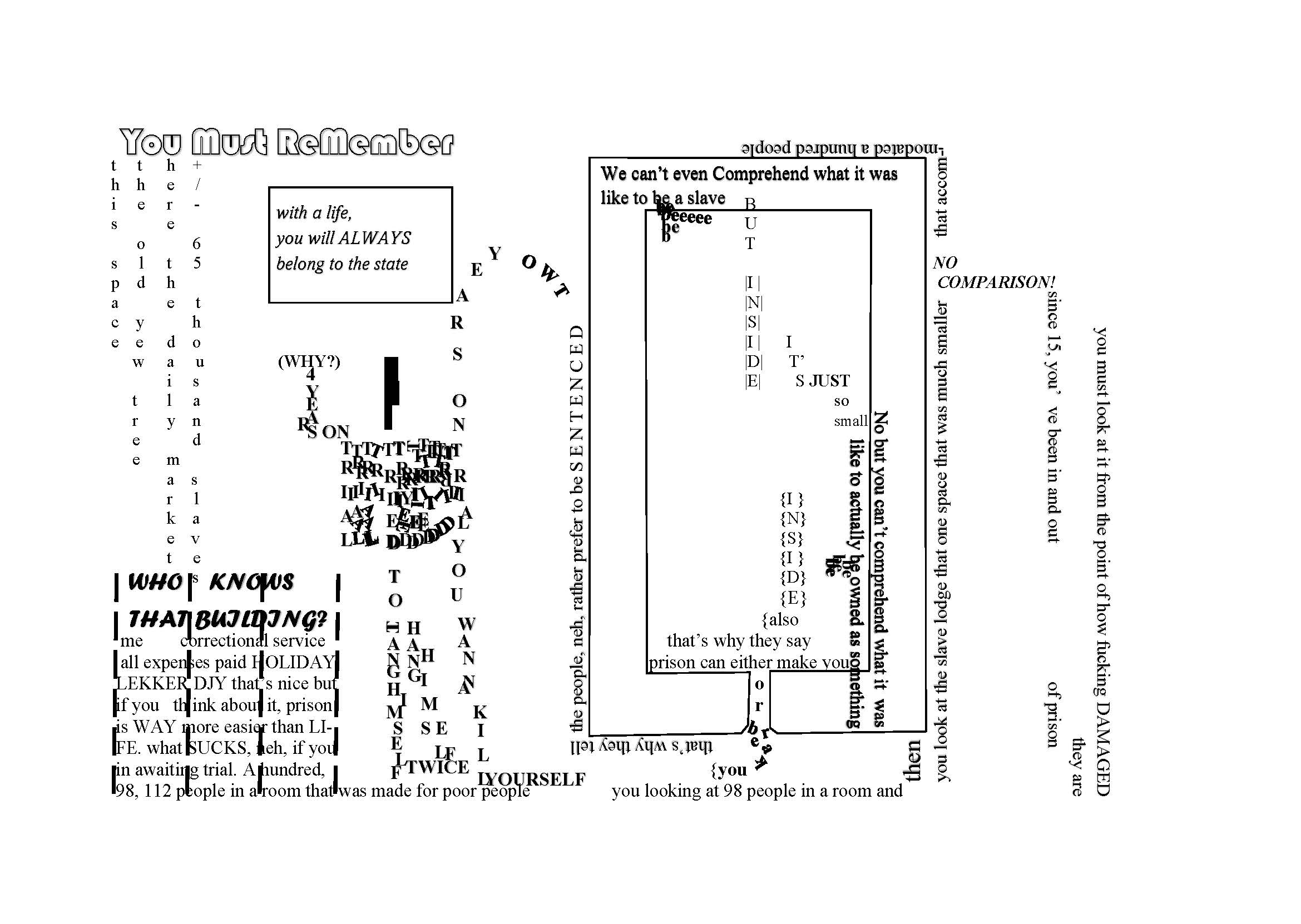
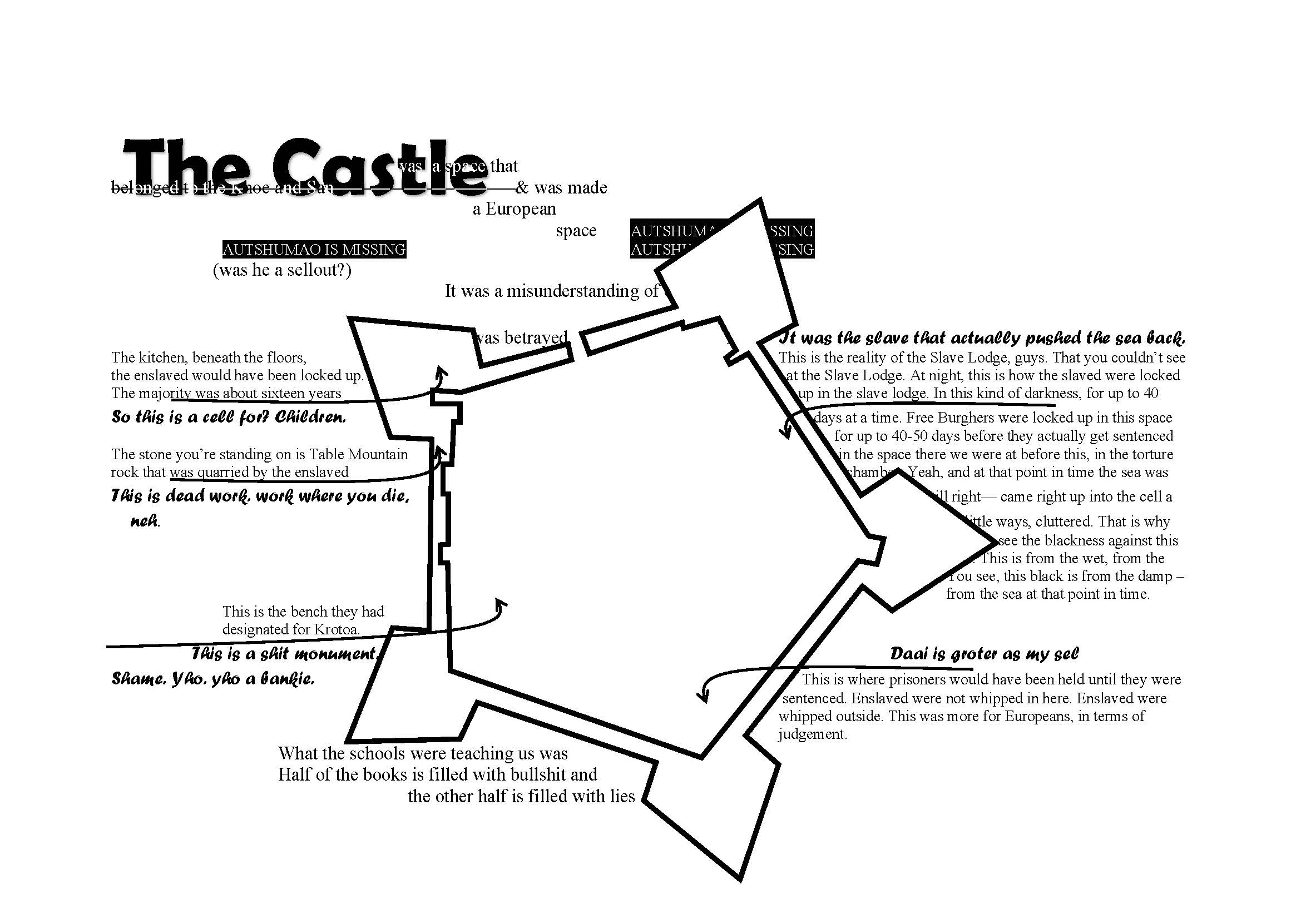
For several weeks after an initial history tour guided by the Social History Educator at the Iziko Slave Lodge Museum, Nadjwa Damon, in which she took the group through part of the Slave Lodge, the group requested a follow-up tour. During this follow-up session, Nadjwa takes the group on a history tour of the Castle of Good Hope, beginning just outside the Slave Lodge at Church Square and making our way to the Castle. In the above poem, the first image presents discussions that take place between Church Square and the Castle. The second image focuses on discussions that take place within the Castle itself. I outline the Slave Lodge and Castle buildings to further demonstrate how the discussions engaged with spatiality itself.
Nadjwa’s contextualization cue (Bloome et al. 2005) in the audio recording “you must remember,” signals a call to memory for the group that is at once necessary for understanding the following insights as it is politically charged with the urgency of undoing layers of forgetting this history. Walking through Church Square, she offers several mnemonic devices to remember this history, including spatialization (“this space”), imagery (“the old yew tree”), event (“daily market”), and a quantitative measure (“plus or minus 65,000 slaves”). This sets up the parameters of the tour: the political urgency of retrieving this memory and the range of mnemonic offerings for participants to engage with. Interestingly, immediately following this discussion of slavery, participants begin a discussion of imprisonment as they walk by a correctional services building. The irony is two-fold: spatially, as the literal site of slave-trading shares proximity to a contemporary site of incarceration; and narratively, as one discussion of racialized captivity folds into another. The latter discussion is insightful. Comparing the experience of being imprisoned as an “all expenses paid holiday” due to its free meals and stable accommodation, prison is placed into a comparison with “life,” the former being proclaimed as “more easier.”
Yet, despite this assessment, the group narrates the realities of being imprisoned while awaiting trial, first commenting on the overcrowded cells (“98, 112 people in a room that was made for poor people”), which then became a comparative analysis of bodies occupying crowded spaces across the Slave Lodge and prison. Nadjwa prompts the comparison: “you look at 98 people in a room and then you look at the slave lodge that… accommodated a hundred people.” We then see a tension between two reactions. First, that there is “no comparison” that can allow one to “comprehend what it was like to be a slave.” Second, that prison (“inside”) is “just so small.” The former makes an ontological comparison, focused on the state of ‘being’ enslaved (“to actually be owned as something”) compared to imprisoned; the latter makes a spatial and phenomenal comparison, focusing on the state of the site itself and how that can “either make you or break you” as, presumably, enslavement did.
At a later stage, another comment is made that, following a life sentence, one does in fact become property, owned and belonging to the state “always.” This latter temporal adverb is critical as it is precisely temporality that creates the conditions for comparability. Notice, for example, how the tension between the two arguments around whether the crowded slave lodge and prison rooms are comparable dissolves as both speakers comment on how a temporal element is what leads one to their own premature death in prison: “two years on trial, you wanna kill yourself.”
This is substantiated by telling us about a common friend (whose name is redacted for anonymity through black highlight) who twice attempted to hang himself while spending four years on trial. Indeed, it is through temporal aspects that we begin to understand the tensions between the “no comparison” and parallel (“just so small”) perspectives. Another comment suggests that the formerly incarcerated, especially once they become homeless, should not be regarded as lazy but rather “from the point of how fucking damaged they are.” Specifically, the damage is lifelong, referring to those who revolve in and out of prison “since 15,” itself disturbingly reminiscent of how, as Nadjwa will soon recount to the group once we arrive at the Castle, the enslaved in the Cape were most often children.
Upon beginning her tour of the Castle, Nadjwa curates the experience by first clarifying that the space itself has been “made” into a European space, given the land belonged to the Khoe and San. She uses Autshumao as an example because his presence is missing as you enter the Castle and are greeted by several statutes that do not include him. This sets the tone strongly because, as most had learned about Autshumao in school through the misnomer ‘Harry the Strandloper,’ it becomes instantly clear that the tour will seek to debunk dominant narratives and complicate the group’s understanding of the history of this site. As we tour the Castle in a counterclockwise direction, the reactions increasingly read as suspicion for how history has been dealt with in the South African education system.
First, there is surprise that the enslaved not only slept beneath the floorboards but were predominantly children. Next, the fact that the Castle itself was built with rock quarried by the enslaved (children) is framed as “dead work,” an approximation of the Castle’s legacy to the death-driven economy of enslavement. Going to a bench that was brought to ‘commemorate’ Krotoa, we discuss not only her story but the meaning of remembering her through such a lackluster memorial. As we enter a space that was previously used to hold, sentence and torture European prisoners, a telling reaction is that “daai is groter as my sel” (this is bigger than my cell). Nadjwa detailed the kind of torture and brutality prisoners experienced here, but the comment is telling about how the participant nevertheless regarded a broader privilege that European prisoners experienced even the relative to the contemporary carceral figure.
Finally, as we approached the end, Nadjwa took us to a holding cell that was pitch black to explain the reality of the enslaved Black at the Slave Lodge. In other words, the experience of the enslaved cannot even be understood at the Slave Lodge itself but instead via the preserved space in which White suffering took place. The walls of this space remain damp from the fact that the sea used to reach the Castle. The response is perhaps the most poetic and profound reaction: “It was the slave that actually pushed the sea back.” Surely, this should be read as an observation that it was likely the enslaved that labored on the infrastructural projects that built up the urban environment where the sea once reached. But it is also a summation of the group’s responses to the tour as a whole.
Whereas the preserved site of White suffering remains intact in a way that their narratives can be viscerally observed, the sites and memory of slave suffering remain silenced: the site under the floorboards of the Castle’s kitchen are beyond reach; the Slave Lodge itself contains no similar dark room that has been preserved as such; Church Square has monuments but, as evidenced by Nadjwa’s skilled guiding strategies, do not suffice as mnemonic devices in the way that a preserved and recognizable yew tree, for example, would; Krotoa’s bench. Considering this sustained discussion, we can also understand the image of the slave pushing the sea back as the invisibilized labor that has allowed and continues to allow Cape Town to remain picturesque and unspoiled by its traumatic past.
The fascinating discussion begins as the group walks, firstly, along key slave heritage sites and, secondly, correctional services. Here, we witness a debate emerge around the comparability of the spaces of the Slave Lodge and prison. Prompted by a comparison between the approximately one hundred people found in both an overcrowded contemporary prison cell and the Slave Lodge, the group begins to go back and forth on whether there is “no comparison” or if the prison is “just so small” and, therefore, comparable to the site of enslavement. On the one side of this argument, the incomparability comes from the notion that the men cannot truly understand “what it was like to be a slave” and “be owned as something.” On the other end, the spatiality is centered and likened. The equivalent smallness of the two sites is not the important factor, but rather the reason that “prison can either make you or break you.” That is, the comparison is substantiated by the memory of a mutual friend who attempted to twice hang himself because he was held in awaiting trial for four years. Two further remarks are made: the formerly incarcerated should be empathized with for the damaging experience of revolving in and out of prison from the age of fifteen; and a life sentence means that, against the earlier comment that the incarcerated cannot comprehend the experience of being owned, one becomes a belonging of the state.
Nadjwa began the tour with several mnemonic devices (“you must remember…this space… the old yew tree… here, the daily market… plus or minus 65 thousand slaves”), and when the group discussion arrives at the comparability between the enslaved and the incarcerated experiences through the memory of the suicidal friend, they do so through similar mnemonic strategies. First, emphasis is placed on space (“inside it’s just so small;” “inside also”). Then, a particular image is given; like the yew tree, the hanging man looms over us as listeners. Third, like Nadjwa’s emphasis on the repetitive temporal loop of daily slave auctions, the group explains that the suicidal friend tried to hang himself precisely due to the prolonged weight of waiting that endlessly suspended the friend in a precarious experience that implicitly feels like a being stuck in a loop desperately needing to end. Just as Nadjwa provides a broader picture of the vastness of the slave trade at the Cape (“65 thousand slaves”), the participants accentuate the full reach of the carceral experience—i.e. beyond the prison and into life on the outside—by stressing the damaging trauma of its high recidivism, particularly starting with teens, and the perpetuality of belonging to the state. The former point—revolving in and out of prison since youth—echoes the initial sentiments that prison is experienced as easier than life itself.
When the tour reaches the Castle of Good Hope, the facilitated discussion unfolds with participants increasingly feeling that true history has been kept from them for a long time until now. Upon hearing that enslaved children were kept underground and forced to quarry the very rock used to build the Castle, the latter is framed as “dead work,” alluding to the underground sleeping and living arrangements as well as the labor-intensive and grueling work this required. “Dead work” approximates the labor system to premature death, while simultaneously centering the deathly disappearance of the enslaved who, even now, remain unknown to the men. It also brings back the motif of death that was introduced in the retelling of the friend who tried to kill himself while jailed in the hold of awaiting trial. Like the daily routine of quarrying rocks, said friend underwent a daily experience that approximated him to premature death.
As we enter the sentencing section that was used to interrogate and torture European prisoners, despite the narrative of torture that is recounted, a participant observes that “daai is groter as my sel” (this is bigger than my cell). The remark reinstates earlier points that the spatiality of contemporary incarceration presents a point of comparison when discussing colonial history. As Nadjwa takes the group to another holding cell, this one used to also hold European captives (Free Burghers to be precise), she uses its preserved darkness and staleness to narrate more saliently what the reality of life at the Slave Lodge was like. Unable to convey this reality at the Slave Lodge itself, ironically enough, the preserved and accessible sites of white suffering provide the men with a more concrete reference for the spaces the enslaved inhabited. Nadjwa further explains that the walls are still damp from the sea that used to reach and pound against the outside of that wall, to which a participant states, “It was the slave that actually pushed the sea back.”
Against the erasure and invisibilization of the enslaved, this statement highlights the fundamental feeling of the group: the enslaved not only built the environment which we had just toured, but they also pushed against the monumental sea itself. The sea, which had once carried the enslaved across it on their voyage to the Cape, becomes mastered by the enslaved figure and, yet haunts through lingering dampness. The slave, having been forcibly trafficked across the sea, was made to then push it back, an act that allowed for a particular preservation of white history and erasure of slave legacy in the city. The legacies of the enslaved, hidden in the darkness, remain noticeable centuries later. Whereas, the slave pushed back the sea and has, nevertheless, been forgotten for his labor, the formerly incarcerated inhabit a world that likewise practices a particular act of forgetting. When the men stated that prison is easier than life (on the outside) and that the often homeless formerly incarcerated are misunderstood, they are pointing to the ways in which they inhabit a world that forgets/silences them.
[1] As per signed confidentiality agreements, research participants’ anonymity is prioritized to ensure their safety. With the exception of workshop and tour facilitators, no names are disclosed. Participants were part of a broader sixteen-week workshop series conducted for my PhD research while I was a doctoral student at the University of Cape Town (UCT). The workshops took place at the Iziko Slave Lodge Museum and involved historical tours and creative arts workshops. Recruitment included snowball sampling, by which participants heard about the workshops through word-of-mouth. Selection criteria included previous incarceration experience. Ultimately, five participants were involved for the duration of the workshop series, all of whom attended the tour described in this paper.
[2] Church Square is located today on Spin Street in Cape Town’s central business district (CBD), adjacent to the Slave Lodge Museum. Originally, the square served as the site of the colonial slave market. The Slave Lodge was built in 1679 and used for those enslaved to the Dutch East India Company (VOC) until 1811. The walking tour went down Spin Street, down Corporation Street, and across the Grant Parade to reach the Castle of Good Hope, which is one of the oldest remaining colonial buildings in South Africa, built largely through slave labour between 1666 and 1679.
[3] As the Iziko Slave Lodge Museum’s Social History Educator, Nadjwa specialises in educating diverse audiences in the Cape’s history of slavery. Nadjwa takes a particularly decolonial approach that critiques how the history and its memory is told and framed. During the duration of the workshop series with this study’s group of participants, Nadjwa facilitated two tours and regularly popped in during other workshops to greet and build rapport with the group.
[4] Each page also attempts to insert the physical structure of specific sites that situate the tour. On the first page, the rectangular shape signifies the Slave Lodge. On the second page, the poem literally walks around the Castle of Good Hope.
Bloome, David, Stephanie Power Carter, Beth Morton Christian, Sheila Otto, and Nora Shuart-Faris. 2005. Discourse Analysis and the Study of Classroom Language and Literary Events: A Microethnographic Perspective. Routledge. https://doi.org/10.4324/9781410611215.
Brooks, Andrew Navin. 2017. A Poetics of Interruption: Fugitive Speech Acts and the Politics of Noise. PhD Dissertation, University of New South Wales.
Brooks, Andrew Navin. 2020. “Fugitive Listening: Sounds from the Undercommons.” Theory, Culture & Society 37 (6): 25–45. https://doi.org/10.1177/0263276420911962 .
Cahnmann, Melisa. 2003. “The Craft, Practice, and Possibility of Poetry in Educational Research.” Educational Researcher 32 (3): 29–36. https://doi.org/10.3102/0013189X032003029.
Glesne, Corrine. 1997. “That Rare Feeling: Re-Presenting Research through Poetic Transcription.” Qualitative Inquiry 3 (2): 202–21. https://doi.org/10.1177/107780049700300204.
Harris, Aleshea, and Douglass Kearney. 2020. “Signal, Noise, and Presencing Blackness.” The Yale Review, 108 (4): 88–103. https://doi.org/10.1353/tyr.2020.0022.
Kearney, Douglas. 2015. “Artist Statement.” In The BreakBeat Poets: New American Poetry in the Age of Hip Hop, edited by Kevin Coval, Quraysh Ali Lansana, and Nate Marshall. Haymarket Books.
Leavy, Patricia. 2015. Method Meets Art: Arts-Based Research Practice. Guilford.
Wells, Kristopher. 2004. “Safe in My Heart: Found Poetry as Narrative Inquiry.” In“I Could Not Speak My Heart”: Education and Social Justice for Gay and Lesbian Youth, edited by James McNinch and Mary Cronin. University of Regina Press.