Stoner, Anne E. 2024. “Desired Paths, Required Movement: A Guide to Traveling With Chronic Illness in This Place.” Global Performance Studies 7 (2). https://doi.org/10.33303/gpsv7n2a128
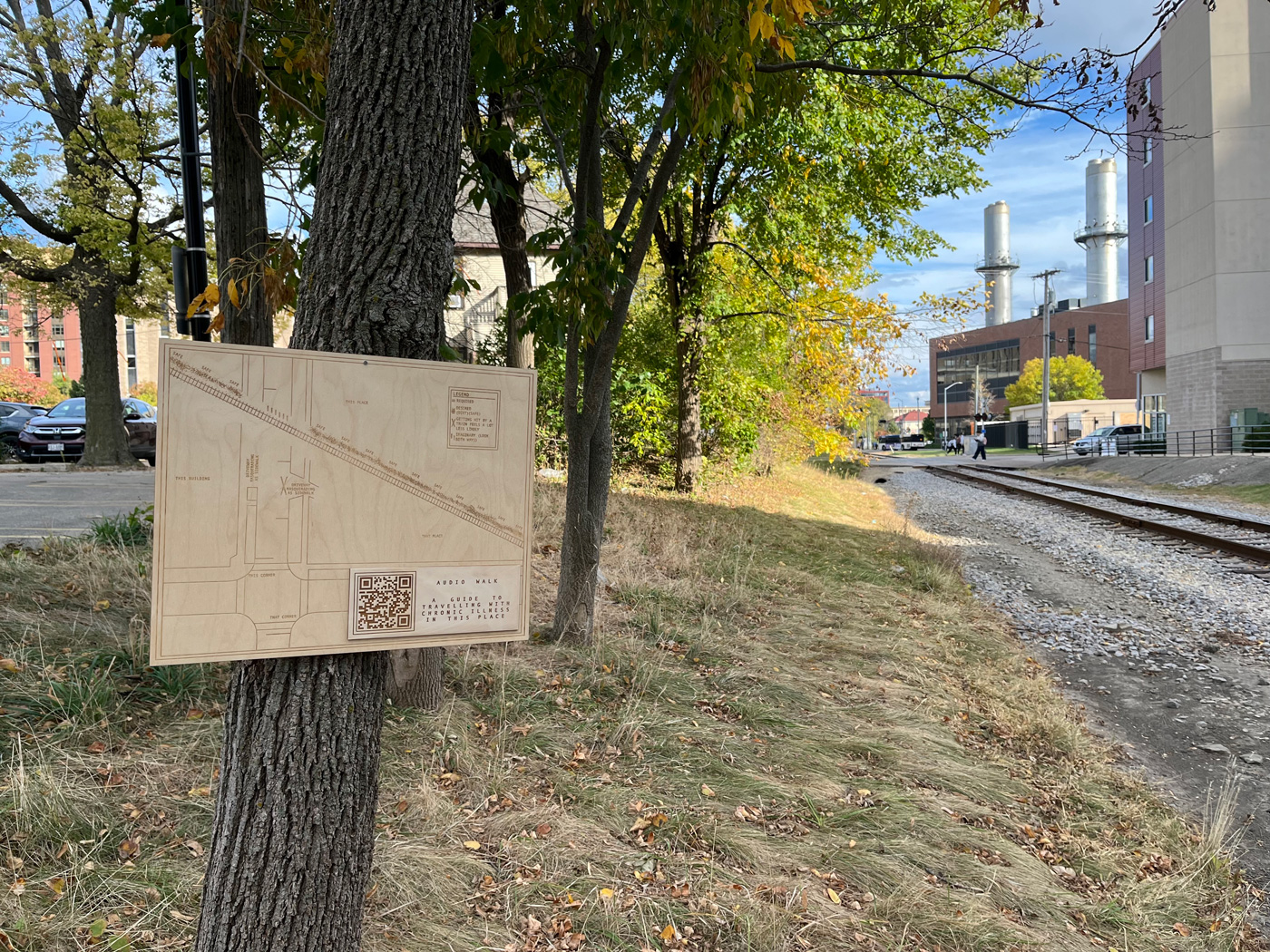
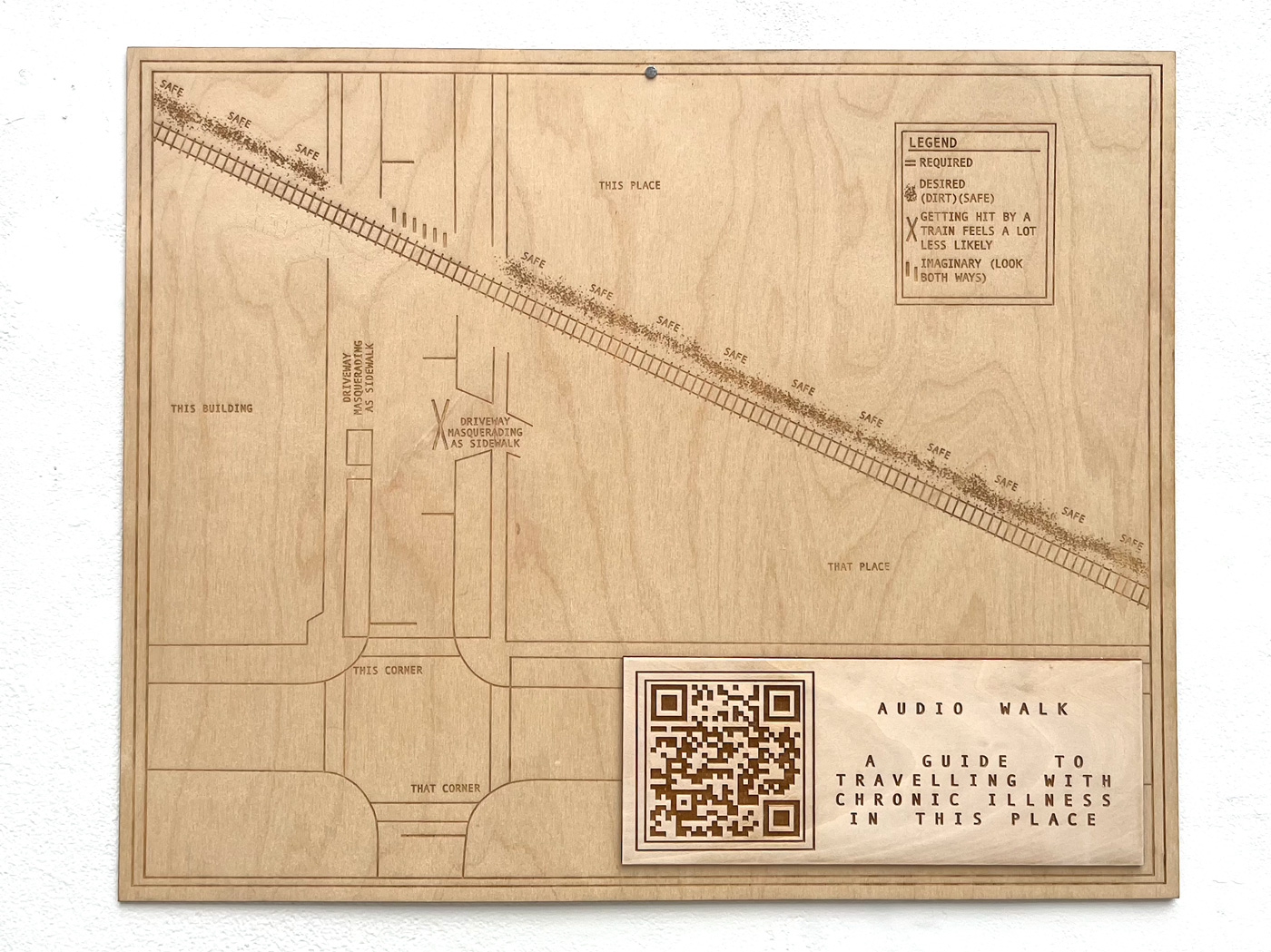
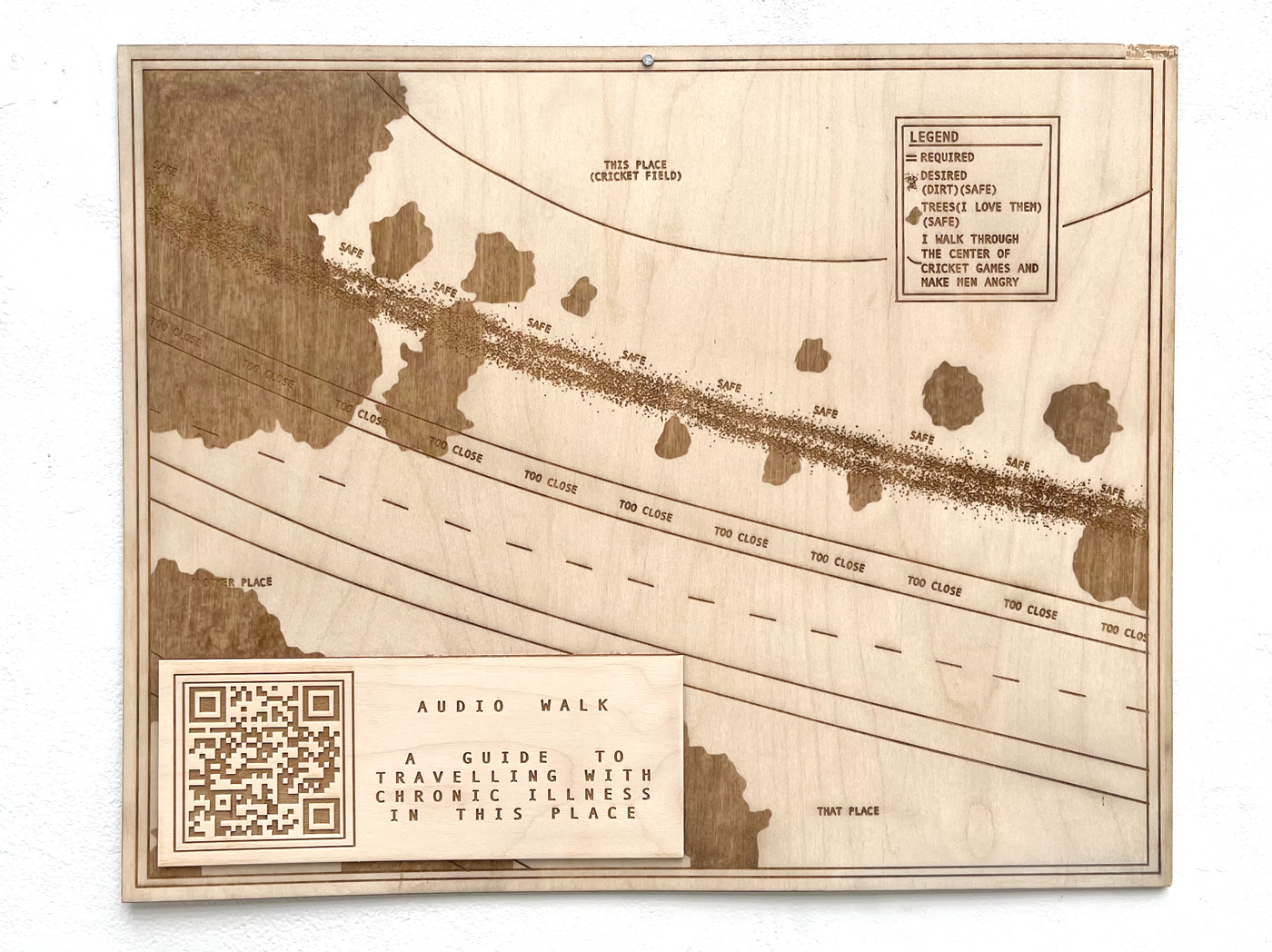
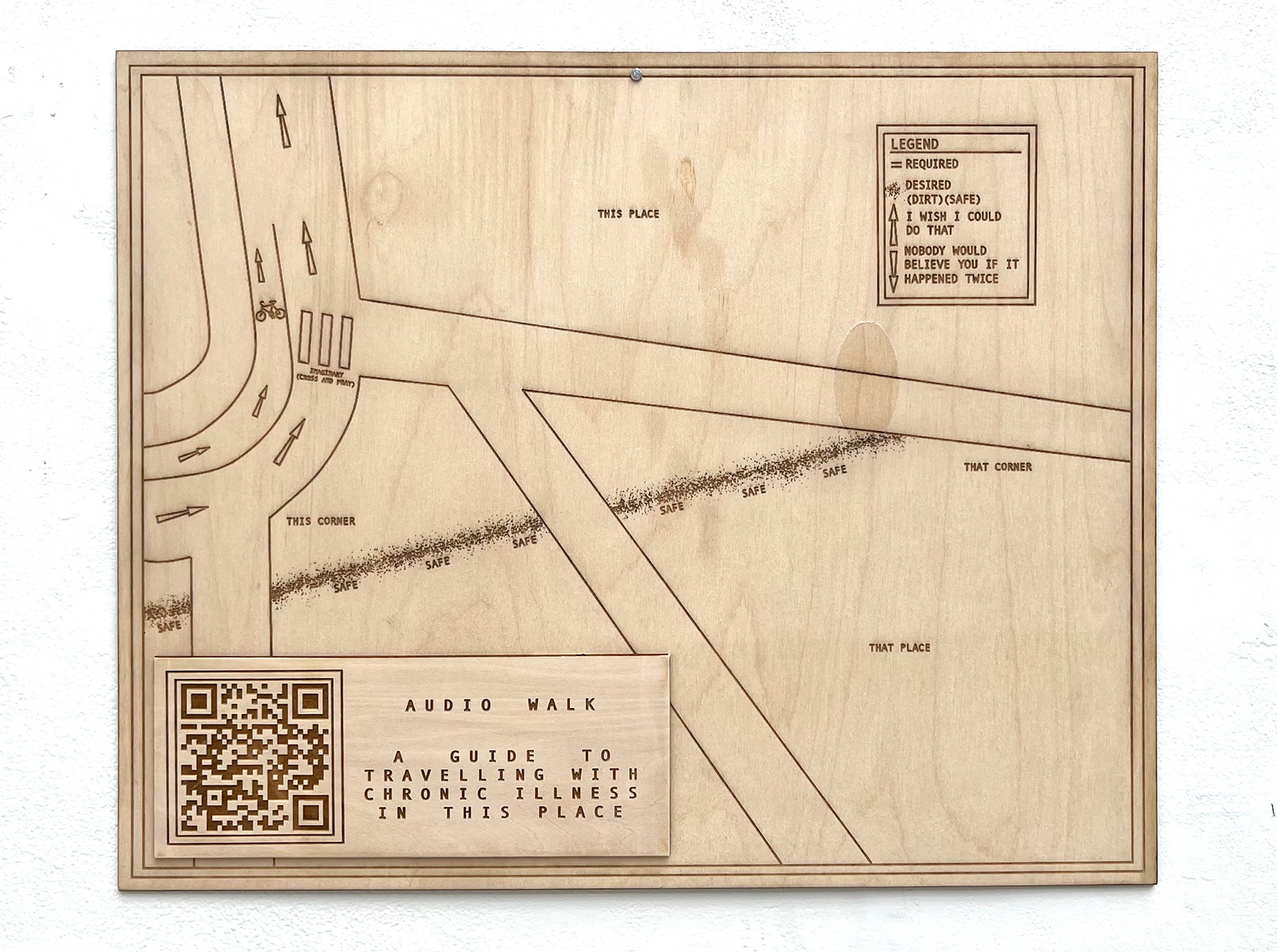
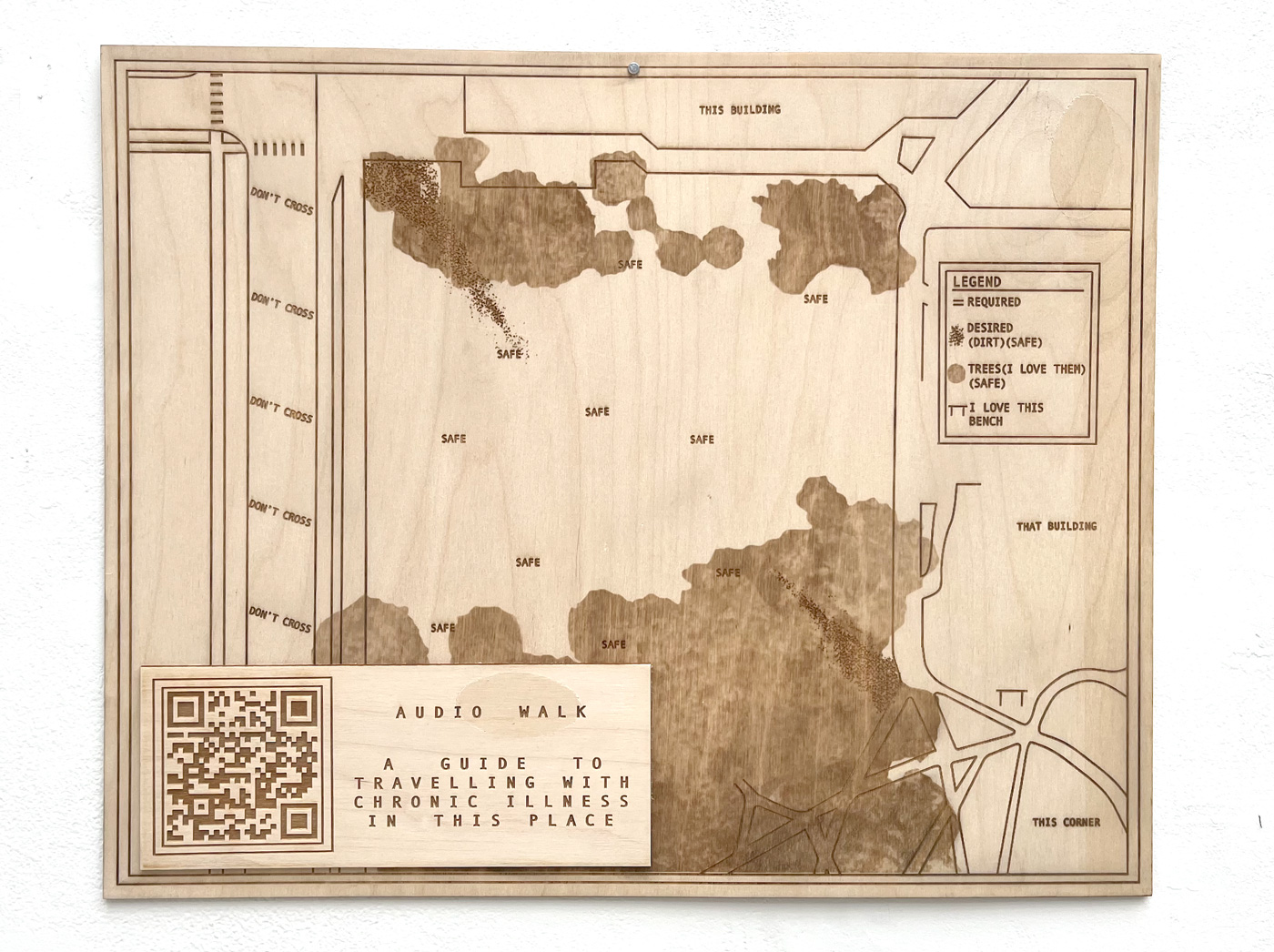
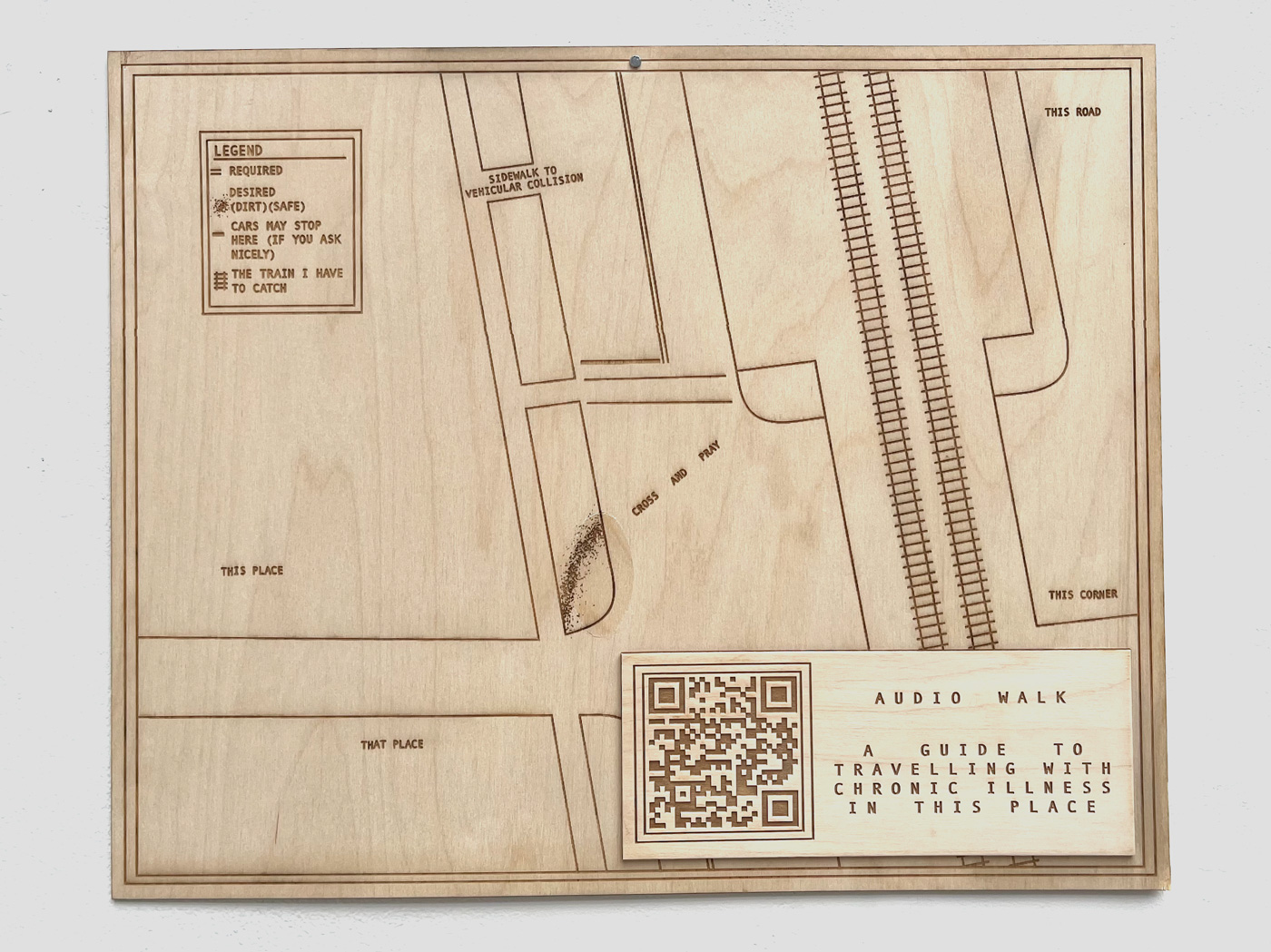
Installations of A Guide to Traveling With Chronic Illness in This Place in Madison, Wisconsin (USA), Edinburgh, Scotland (UK), and Evanston, Illinois (USA).
Listen on Bandcamp | Subscribe on Apple Podcasts | Subscribe manually via RSS | Download as mp3
Hello, and welcome to this place. This place is located next to that place, and this corner, and that corner, and that place. There is also this building, and that building too. There is also a path which is safe, and a path which is less safe. The safe path, pictured above, allows for free bipedal movement separated from built infrastructures, built distance, and built dangers. The safe path, the desired path, often forms a triangle with the required path, where this required route forms the geometric sides A and B, and the desired route forms C, the shorter of the two routes. I encourage you to take this route where you are able. Desire where able, require constantly.
This map maps this place, a place which is next to that place, and this corner, and that corner, too. That is to say, while this map is this place, this map is every place. Or should I say, every place where you may encounter infrastructure which hinders your movement to the next place. I encourage you to allow this guide to guide you through this place, on your journey from this place to that place. Should you choose to move directly from this place to that place, tread carefully. Should you choose to wander, tread more carefully. Traversing unknown physical environments may result in unknown physical outcomes.
I encourage you to become familiar with the locations of curb cuts, of street crossings, of infrastructure which allows for your existence. Reminder that built infrastructures invite built dangers.
A mode of movement which is already non-normative must not become increasingly so. Where our non-normative movement may be our method by which to move forward, may be our method by which we identify one another, may be our method by which we make space for ourselves, our environment is not kind to this non-normativity. We do not have the luxury to wander by way of non-normativity.
I think that I cannot preserve my health and spirits, unless I spend four hours a day at least—and it is commonly more than that—sauntering through the woods and over the hills and fields, absolutely free from all worldly engagements.
(audio reference 1: Thoreau 1862, 658)
There is a chance you are not physically able to saunter, only to move.
Do not equate a Euclidean distance with an experienced one (audio reference 2: Blanchard 2020). A half mile does not sound like a lot to your abled friend. You must reserve energy to move from point A to point B to point C to point D to point E to point F to point G to point H to point I to point J to point K….
[FOUND:]
The Letterist International, and after them the Situationists, had two techniques that they believed were keys to changing the world. These were very tiny, almost paltry techniques. One was the derive, which means to drift. And that meant people wandering through cities, being simply pulled by the attractions that you could find in a city - or repulsed by things that were ugly and hateful. Simply letting the city itself, its streets, its buildings, its ambience, its mini-climates, guide you, draw you down, making you see the city that you lived in in an utterly new way. This was a way of discovering utopia, of discovering what you hated and what you loved.
(audio reference 3: Bogdanov 1989, 00:03:58–00:04:55)
Do not “drop your relations” (audio reference 4: Bogdanov 1989, 00:03:58–00:04:55).
Do not “drop your work and leisure activities” (audio reference 5: Bogdanov 1989, 00:03:58–00:04:55). Do not “drop all your other usual motives for movement and action” (audio reference 6: Bogdanov 1989, 00:03:58–00:04:55).
Do not “let yourself be drawn by the attraction of the terrain and the encounters you find there” (audio reference 7: Bogdanov 1989, 00:03:58–00:04:55).
… for fear of falling, of breaking, of vehicular trauma, of emotional trauma, of sexualization, of profiling. For fear of the attractions of the terrain and the encounters you find there. Do not stray too far from your pharmacy or your hospital system.
Do not allow yourself to become a revolutionist in the Situationist lens. Do not allow a Situationist to convince you otherwise. Do not drift if you are not able.
[FOUND (In Danish, with English overdub)]:
A new district begins with a step into the unknown. like treading down onto a step you didn’t see. The glances of passers-by tell me I will live again. Their smiles promise more here than anywhere else. The dialectics of flânerine: On the one hand, a man who feels observed by all, suspected. On the other hand, one who feels untraceable, secure.
(audio reference 8: Jensen 1988, 00:17:00–00:17:18)
Should you encounter the flaneur, do not allow him to convince you to “wander the city, with no purpose or destination in mind” (audio reference 9: Springgay and Truman 2018, 54). You must not lose yourself in the crowd. If you are not able-bodied, cisgender, white, and male, the rules for the flâneur are not the same as the rules for you. Should you break the rules, tread carefully.
[FOUND:]
Yes sir, yes madam, I entreat you, get out of those motorized wheelchairs, get off your foam rubber backsides, stand up straight like men! like women! like human beings! and walk—walk—WALK upon our sweet and blessed land!
(audio reference 10: Abbey 1988, 233, discussed further in Kafer 2013, 132)
[FOUND:]
Now it’s time for perspective and it’s one of the defining features of a human being, walking upright on two feet.
(audio reference 11: France25 2019, 00:00:00–00:00:06).
[FOUND:]
[Interviewer:] If it’s true what they say that it is about the journey, not the destination, then author Dan Rubinstein has some advice for all of us: walk. In his new book, he ventures out across the globe to explore the power of traveling by foot and reports back with a path to a better world.
Dan Rubinstein joins us now to talk about his book Born to Walk: The Transformative Power of a Pedestrian Act. Welcome.
[Rubinstein:] Thank you.
[Interviewer:] Man, I really liked reading this book. So we’re here we’re going to talk to you in the next half hour about the health and the socio economic benefits of walking. But first, I want to talk to you about the subtitle, “the transformative power of a pedestrian act.” Why is walking more than just a matter of getting from one point to the next point?
[Rubinstein:] To answer that question, I think it’s helpful to kind of go back to the, to the very beginning and to look at our very origin as a species. So when, when human beings became bipedal creatures who began standing up and walking on two legs, that had a tremendous impact on the development of our bodies, you know, we’re not particularly fast or strong creatures, but we have this incredibly energy efficient gate that gave us stamina, and that stamina allowed us to survive and thrive as a species.
(audio reference 12: TVO Today 2016, 00:00:00–00:01:14)
If you are the owner of two legs which give you stamina, be grateful. If you use a mobility aid, proceed with caution. Be aware that your existence may force others to recognize their own fragility. If you feel like an invalid, this is okay. I feel like one too. Have a sit at your nearest bench and take a breath. Walking is not a requirement for humanness. Wandering is not a requirement for happiness.
“…the history of walking research engenders a ‘fraternity’ in that it tends ‘towards an implicitly masculinist ideology. This frequently frames and valorizes walking as individualist, heroic, epic and transgressive” (audio reference 13: Heddon and Turner 2012, 224). You do not need to be a hero on your commute.
Do not desire beyond requirement. If you encounter a desire path, you may take it, but do not do so out of desire. Do so out of requirement. You must interact with your city in a prescribed method until this is no longer an option. When this occurs, proceed with caution. Beware: You may fall victim to the social disability model, it may be your environment which disables you, tread carefully.
Do not jaywalk, but do jaywalk. Jaywalk when it reduces your experienced distance enough to make the journey tolerable. Calculate this risk daily. Reminder that you are in “car country” (audio reference 14: Wells 2013, 2), keep your distance. Keep an eye out for, “walls, bars, gates,” “to be a pedestrian is to be under suspicion” (audio reference 15: Solnit 2001, 11).
Reminder: While infrastructure may aid your quest to reach your destination unharmed, it may also hinder you. Maintain a safe distance from moving vehicles, moving bicycles, stationary vehicles, stationary bicycles - any object which is still may begin motion. Your chances of making contact with a moving vehicle are low but not zero. Your chances of being catcalled are likely moderate and certainly not zero. Your chances of being harassed, berated, made the victim of violence, assault, your chances of becoming injured, of fainting, of falling, of becoming ill, are never zero. Ultimately, the choice to take a shorter, more direct path, which decreases both Euclidean and experienced distance, may simply be a choice to decrease the amount of time spent vulnerable to the infrastructure of the city, itself.
From our community, we hear accounts of experiences had while traversing the city non- normatively, or in a way which is prescribed as such. Amy Kavanaugh writes:
As a visually impaired woman who navigates the world with a white cane, I get touched by total strangers every day. I feel like public property and it’s exhausting, ‘I’ll look after you.’ He started stroking my arm, and touching my breasts, telling me that he wanted to take care of me. I struggled free but as I started walking away he followed me, asking
- Where I lived
- If I had a boyfriend
- Which train I was going to catch
- Saying he would come with me and take care of me.
(audio reference 16: Kavanaugh and Bish 2019)
Others in our community are “accused” of wandering when simply moving. Mel, formerly Amanda, Baggs states,
When non-autistic people walk out of their homes, they are “taking a walk” or “walking somewhere” or something like that. When autistic people walk out of our homes, we are… wandering! I don’t know what it is that gives people that impression. But I have been accused of wandering when:
- Taking a walk.
- Waiting outside rather than inside for staff to show up.
- Trying to take a bus.
- Running away from a fight that broke out at a day program.
- Leaving the room to avoid reacting physically in anger.
- Trying to escape institutions.
- Going on long walks to explore the geography of an area.
(audio reference 17: Graby 2012)
We look to other communities and see “wandering” used as a tactic of control, in opposition to the valor the word holds when applied to the able white male. In “Blackness as Trespass,” Jefferson-Jones and Henderson (2020, 879) cite the history of the “radicalized crime of ‘vagrancy’” in the United States, where “criminal trespass” brought about the arrests of young men throughout the South during Freedom Summer (audio reference 18), and more generally criminalized the simple existence of Blackness. Cadogan details his experience of walking in New Orleans and New York City, and the “rules” he set for myself:
Quite unlike the invisible and detached flâneur, “Cadogan’s ‘tactics’ emphasize the material realities of ‘walking while Black’” (audio reference 20: Springgay and Truman 2018, 55). Flâneur, wanderer, jaywalker, trespasser, nuisance. Where one falls on this spectrum is dictated by their body; its abilities and its threat to white supremacy.
If you are accused of wandering, instead of applauded, tread extremely carefully. You must always appear purposeful, appear worthy, appear useful. What can a body do? What does the presence of the non-white and unable body do? Should your social infrastructure and your physical infrastructure hinder you to the point of complete inability….
[Pause]
Should you desire spontaneous exploration, should you desire enjoyment in movement, should you desire….
[Pause]
This map maps this place, a place which is next to that place, and this corner, and that corner, too. This map maps your place, a place which you traverse on your way from this place to that place, on your way from point A to point B to point C to point D….
The desire path gives us, those who are chronically ill, a taste of wandering. Situationists and flâneurs alike would stand in awe of our non-normative movement through the city. Thoreau might valorize our choice to wander across the fields in place of stepping onto the pavement. However, where our method may be congruous, our rationale is entirely opposing. Where the city’s infrastructure does not serve us properly, we are forced to build our own infrastructure. We are forced to create our own safety. We are not drifting, we are just moving the best we know how.
Abbey, Edward. 1988. Desert Solitaire. University of Arizona Press.
Blanchard, Enka. 2020. “Discreet Crips in a Discrete World: Spatialities and Temporalities of Disability.” EspacesTemps. https://www.espacestemps.net/en/articles/discreet-crips-in-a-discrete-world-spatialities-and-temporalities-of-disability/.
Bogdanov, Branka, dir. 1989. On the Passage of a Few People Through a Rather Brief Moment in Time: The Situationist International 1956–1972. https://www.youtube.com/watch?v=ncH0-q9OXco.
Cadogan, Garnette. 2016. “Walking While Black.” Literary Hub, 8 July. https://lithub.com/walking-while-black/.
France24. 2019. “Why the Humble Act of Walking is Actually a Superpower.” Youtube, 5 September. https://www.youtube.com/watch?v=1Ya9UDjeNjU.
Graby, Steve. 2011. “Wandering Minds: Autism, Psychogeography, Public Space and the ICD.” Paper at the Critical Disability Studies conference, “Theorising Normalcy and the Mundane,” Manchester Metropolitan University, UK.
Heddon, Deirdre, and Cathy Turner. 2012. “Walking Women: Shifting the Tales and Scales of Mobility.” Contemporary Theatre Review 22 (2): 224–36. https://doi.org/10.1080/10486801.2012.666741.
Jefferson-Jones, Jamila, and Taja-Nia Y. Henderson. 2020. “#LivingWhileBlack: Blackness as Nuisance.” American University Law Review 69 (3): 865–914. https://digitalcommons.wcl.american.edu/aulr/vol69/iss3/3.
Jensen, Torben, dir. 1988. Flâneur III: In Walter Benjamin’s Shadow. The Danish Film Institute. https://www.youtube.com/watch?v=H7eT-qNDw6M.
Kafer, Alison. 2013. Feminist, Queer, Crip. Indiana University Press. https://doi.org/10.2979/6841.0.
Kavanaugh, Amy, and Hanna Mason Bish. 2019. “As a Disabled Woman, I’m Harassed on the Street Daily—Where’s My #MeToo Movement?.” Huffington Post, 29 July. https://www.huffingtonpost.co.uk/entry/disabled-woman-me-too_uk_5d3eaee2e4b0db8affaadf12.
Solnit, Rebecca. 2001. Wanderlust: A History of Walking. Penguin.
Springgay, Stephanie, and Sarah E. Truman. 2018. Walking Methodologies in a More-than-Human World: WalkingLab. Routledge.
Thoreau, Henry David. 1862. “Walking.” The Atlantic. https://www.theatlantic.com/magazine/archive/1862/06/walking/304674/.
TVO Today. 2016. “Born to Walk.” Youtube, 22 July 2016. https://www.youtube.com/watch?v=KZ_u2Sx_WLc.
Wells, Christopher W. 2013. Car Country: An Environmental History. University of Washington Press. https://doi.org/10.1515/9780295804477.