 Preston, Julieanna. “A Letter Last: When I’m calling you-ou-ou-ooooooooooo.” Global Performance Studies, vol. 7, no. 2, 2024, https://doi.org/10.33303/gpsv7n2a126
Julieanna Preston
Today
Dear Reader, whomever and wherever you may be.
This is the last of eight letters. The first seven were written and performed as a series of geographically situated spoken word events. Those letters shared my life adventures and wonderings with my great-grandmother, a woman with her own experiences of migration, loss, and love in relation to home and belonging. To prepare for writing to you, I have revisited each of the performance locations on the same day, now three years later, to critically reflect on the work, and hopefully understand what potential the performance prompted and what possibilities it left open.
This eighth letter performs in the space of the pages of the Global Performance Studies journal issue with the long title: “Uhambo: translating embodied wanderings into performance practices and epistemologies through audio/multimedia walks.” I feel compelled to explain why this essay should be included in an issue that obviously pitches to walking, a performance practice that has been revived in recent years. Honestly, no walking takes place in this performance nor the essay. If anything, it’s more constellational: swarming, flocking, fogging, aggregating, or weeping that move in ways akin to dust, pollen, gnats, storms, and swollen rivers. I am latching onto the embodied wandering portion of the issue’s title in relation to journeying, migratory movement and cultural exchange across space and place as a practice of intersectional experience. Travel, in this situation, occurs in the aether, on the wings of sound’s body, drifting into the eddies of histories remembered and currents pushing the envelope of the future. Fluid or gaseous, it is temporal and ephemeral. Uhambo? Perhaps, though I am not yet convinced that the performance or the essay is “self-controlling” or “self-fulfilling,” attributes that feel inconsistent if even contradictory to the work. For in fact, the original performance was a conversation with the immediate physical environment, the “then and there” of place, as much as it was an interaction with material transportation—maybe, transmission—of metaphysical data, largely invisible yet incredibly tangible, wild atmospheric chemistry. I think this essay, including this letter, may be the most physically substantial artefact of the whole artwork.
It seems fitting to punctuate this performance with a full stop letter to you, because, while it continues the closeness of a private message, it multiplies its readership exponentially to a public, especially one well beyond the borders of Aotearoa. Together, we can delve into circumstances that incited the performance and forces, visible and invisible, that morphed it as it was happening, all fairly subjective and contingent stuff supported by trust in my method and your enthusiasm to continue reading.
So, some hardcore data to set the scene for you; it matters to some. The performance HARK was performed 22–28 February 2021 as part of the Performance Arcade’s series “What if the City was a Theatre?” (Preston 2021). Each night between 8 and 9 pm, as the day turned to night, I read a unique letter at the site of a house I have lived in since immigrating to Aotearoa in 1997. Those seven houses are located across the Whanganui-a-Tara region. Attendance varied from a dozen to maybe fifty people each night, I think, depending on the weather and the distance from city central. I had delivered notification letters to the current residents of each house to alert them of the event, promising to keep unruly throngs to the street by health and safety helpers. Performance Arcade took care of marketing as I did by word of mouth.
The word “hark” refers to a calling, a cry to listen, a movement backwards in time-space, an arousal, and a stirring up to cross the geographical and temporal distance between us. HARK was an utterance and gesture that mixed storytelling, self-reflection, and a curiosity to know who I am (and could be) as a Pākehā, a long-term white settler visitor, originating in faraway lands, marked by other waves of immigration from Croatia, Netherlands, Wales, and the United States. I was attempting to figure out how I belong in this place by plotting an imaginary trajectory to an ancestor. Reading the letter was a performative gesture that launched a message and a song-line, casting wairua—a word I don’t use lightly, a word I employ with the greatest respect, a word that Māori, the indigenous people of this land, use to refer to the non-physical spirit, the sneeze of life, breathed into the body to create humankind, the intrinsic life force that allows one to relate to others (Te Aka/ Māori Dictionary n.d.)—to my great grandmother Stança, across the neighbourhood, the city, the harbour, the island, the oceans, the canyons, the prairie and the cemetery (Ngawati 2018, 8). The word wairua, for me, is untranslatable; it is something that the English language cannot hold. With wairua, everyone present was drawn into a unique collision of weather, place, urban ambiance, my posture, gestures, and vocal elocution in relation to intimate correspondence that engaged the city as a spatio-temporal theatre, life as performance and the air waves as conduits to other spatial dimensions, imaginary yet real all the same. The performance was premised on a belief that our histories and people travel with us in the pores of our skin, those millions of miniscule valves that breathe in both directions.
Do you feel the life force of things?
Each evening of the performance, I looked into the eyes of the audience to feel how their energy was mixing with the weather of the moment. They may not have realized that they were performing as well. Here and now, amongst these bits of pixelated data on the screen of this journal issue, I am not that fortunate, as it is likely we have just met, and the page is not a conduit that allows me to absorb nor reflect your name, smell, or smile; the limits of this page confound a full-flesh experience. But it is possible to regard my experience of writing this letter to you, and your experience of reading it (even though it is one-sided) as somehow transmissible in similar ways.
Stand-up comedians and monologue actresses know a great deal about this mode of exchange, of which I am neither.
Where do you come from? How many times have you moved house or country? Is your great grandmother still alive?
In Aotearoa, it is customary to introduce oneself in relation to the land and ancestors, a kind of registration of who and where you come from that begins a relationship. This letter and the sound files—the detritus from HARK—could be considered a very long introduction. I adopted this ritualised habit of introduction, at first to try to fit in, and more recently as a nod to being an ally to the Indigenous people of this place and to honour their ways. Not merely behaving out of respect, I have a feeling that I am slowly and provisionally being adopted by a place I wish to call home, yet a place in which I am considered a long-term visitor. In a like manner, you will find me adopting a common notion of what letter-writing does:
As a genre, letters have specific forms of deixis, that is, ways of referring to the writer and the intended reader and to space and time. The writer is present in the letter, often through the use of the word I and in the signing of the letter. There is usually a specific reader, or readers, in mind and they are invoked in the salutation and in the use of you. The writer constructs an intended reader in the text. Time and space are important in that spatial distance is often the main reason for the letter’s existence and there is a time lag between the writing and the reading. Two worlds are invoked: the here and now of the writer and the here and now of the reader. Shared knowledge is referred to, often explicitly. (Barton and Hall 2000, 6)
What can I offer to preface what can be gleaned from the letters to follow? For in fact, these letters are all about me. And not. These letters are far more than just about me. Prior to 2020, I used the humanities-centric method of autoethnography to defend my use of personal material, including writing in first person, to contextualise, critically position and reflect on my performance art works. I also wrote in forms such as life-writing, fictocriticism, site-writing, art-writing and performance writing, noting that they share many qualities and strong associations with feminism and women’s studies literature that uses autobiographical material. Lauren Fournier’s book Autotheory as Feminist Practice in Art, Writing and Criticism (2021) helps me to grapple with questions about why I need to explain myself and my artwork. I wonder: Does the artwork not present itself as a compelling argument, position, or provocation? Can’t one just feel it, abandon all trappings of intention, what pretends to be the singular reality, and yield to the moment? Why must I adhere to the conventions, authority, and proprieties of a patriarchy with a long-term habit of dismissing feminist, subjective, “I” inflected writing as narcissistic, egotistical, solipsistic, petty, uncritical, non-intellectual, non-conceptual or as heavy-handed confessional? (Alenius 2011).
Fournier, herself an artist, writes with a knowing of the idiosyncratic, unrepeatable, and associative thought and making processes so often activated, and not always couched in logic or reason by artists.
Autotheory is most simply, the combination of autobiography and memoir with theory and philosophy (as practices of theorizing, of philosophizing). That self/other form recurs in autotheoretical writing—the form of a memoir or personal essay alongside footnotes, endnotes, marginalia, research. It follows in an academic tradition with bibliographies and citations while expanding beyond it and transforming it. It opens up not only what memoiristic work can be, but also what academic work can be. (Berggren 2022)
Fournier’s words ground my writing with the confidence to imbue it with a deep commitment to feminism, to couch philosophical concepts in stories ripe with metaphor, to wax poetically on all matters simultaneously personal and political, and to explore what the spatio-political agency of invisible energies as spirit matter. Fournier helps me glean more from Erin Manning’s advocation (and defense) of the significance of the minor gesture, a deeply intelligent element of everyday experiences and phenomena which attend to making theory by virtue of just how non-abstract they are (Manning 2013, 1–25). “Autotheory reveals the tenuousness of maintaining illusory separations between art and life, theory and practice, work and self, research and motivation, just as feminist artists and scholars have long argued” (Fournier 2021, 2–3).
How serendipitous that last night I saw a performance by a group KOPU that asked the audience to leave their white feminism at the door. They made a convincing case that Māori wahine was not the same as being a woman—the words wahine and woman are worlds apart. I may need to rethink my position on being a feminist.
Still with me?
So, why letters?
Letter writing is recognised as a woman’s genre, especially in English literature, “a lonely sort of conversation”, “a gift of words written to a familiar person,” that offers a writer a sense of power to reveal things they may not normally expose, especially in public; “[...] they invent shadows of ourselves to speak for us” (Luu 2019). I cringe at the generalisation inferred about women and writing, yet the reality is that the history of women writing letters is substantial and known for the way it nurtures social connections, across great distances, time, and cultural events. Such “technology of the self,” as Foucault ([1982] 1988) states, enabled one to retreat into a space of introspection that afforded ordinary people to develop an intricate, emotional inner life and share it in a lady-like manner (2). Previously thought to be harmless, idle, trivial, and personal, letter writing was recognised for being akin to spoken conversation, synchronous, spontaneous—grammatically complex at the “edge of literariness” (Guillén 1994, 21). Over the centuries, letter writing by women shifted from a dutiful act of good taste to a subversive, rebellious and rule-bending literary genre (Luu 2019). When writing the letters for HARK, I felt as if I was bearing a personal truth, letting a reader get close to my specific life while pointing to vibrant and distressing issues of this time and touching on past histories, dreams, and unfulfilled fantasies (Maupin 63). It never occurred to me that I was practicing a gendered stereotype. At risk of invoking nostalgia, the nearly dead art of cursive writing on non-lined paper, tucked into a scented envelope, and sealing it and the stamp with a bit of spittle has kept many a relationship alive as I moved house many times. A box of replies in the form of letters and cassette tape recordings from my father, friends, and lovers still hides under a blanket on the top shelf of my closet, archiving the fragrance and DNA of their touch. Made distant by decades, these letters teeter in a liminal zone of fiction and non-fiction; their realities become unstable, or better, waffle (Guillén 1994, 5).
There is hardly an act in our daily experience, rooted in life itself, that is as likely as the writing of a letter to propel us toward inventiveness and the interpretation and transformation of fact: hence the ambivalence of the product, on the razor's edge between the fact and the interpretation. (Guillén 1994, 5)
Do you recall the pleasure of writing a letter? Of imaging the recipient lingering on the lines while deciphering the strokes of your pen? Of tearing up at the magic of letters to compress geography, a binding, and hold you at bay, a spacer?
In writing these letters to my great-grandmother, I was attempting to leap over several generations to unearth a genealogy that is full of gaps. I was looking to find my kin, a word that I associate with the warmth of family more than just the ancestral linkages through begetting. I was looking for an anchor to counter a long-term feeling of being un-homed, a bit lost, adrift, not belonging, foreign, even alien to most everything around me. This place Aotearoa had caught me out; it had, and continues to, trump all the skills I had put in place over fifty years and fifty houses to adapt to a new place unaware of the extent of my privilege and the impact it had/has on others. I found advice on how to be “a good Pākehā” in the texts of Alison Jones (2020), Jen Margaret (Winter 2019), and Tina Ngata (n.d.), not always easy reading but intelligent, forthright, and necessarily confronting. (It is not surprising that each of these women is a feminist and activist to some degree.) I owe a great deal to numerous friends for offering wisdom and guidance, if even a shoulder to cry on when my white fragility shows its ugly face: I cherish their words like I do their privacy.
Read/listen to the letters; it’s all in there.
It would have been much easier to seal the letters and add them to the box in the closet for my daughter to stumble upon after my passing. That would have kept them private instead of performing them as spoken word as I did to friends and strangers, in the public sphere, made and laid bare out in the street, amongst all the other mundane elements of urban dwelling. Yet that would defeat any hope I had of sparing or reducing the same pain of others or modelling one version of personal-political transformation of self.
Such willingness—no, eagerness—dwells in life and art equally, not parcelled but instead, as one and the same thing, is not foreign to me. For the most part, they are indistinguishable from one another on a daily basis such that something as common as softening a block of butter for baking, drawing a rose-petal bath, or carrying a bag of fruit from the market are performances embedded and undetected from daily habits (Preston 2023). Making creative work is a drive I can’t turn off or dial down. It forms a “vexing” relation that blurs the boundaries of art and life in ways that dispute them as “discrete, circumscribed areas of existence” (Patrick 2018, 2). The letter-writing became a performance because I felt the need to come out of retreat/victim mode, to address what was unsettling. That process demonstrates, I hope, an on-going and alternative practice of making home, something I have found to be precarious in this bi-cultural country. Little did I know then that delivering the performance would reveal that one antidote to my malaise was to abandon an inherited myth of what belonging was or felt like. To open one’s heart, mouth, and doubts—this is the risk, the bravery, the vulnerability, the subjectivity that that begs with Autotheory (Fournier and Matharu 2021). It’s the same risk that I know all too well when doing a durational place-responsive performance; anything can happen and does. That risk is the adrenalin inducer that resists taming as I transition from ordinary everyday life to a heightened state of everyday performing life.
None-the-less, I do have a few “rules to live by” to make my art. I am always myself, or rather, one of my many dimensions of self; it is not acting. My props and costume are best when they are pared back, nuanced, and close to what I would wear on any given day, which is usually a tee-shirt and jeans. I develop a score based on the place and what it affords and some initial intentions—never a script that dictates when and what. This enables contingent responsiveness to the atmosphere of the place at the time of the encounter. The performances are durational, the longer the better, which allows for emergent forces, patterns, and events to make themselves known and for me to “get out of my head” and “out of my own way.” Improvisation is key and hence, awkward, splendid, and immersive. Detached moments occur unexpectedly and unintentionally; sometimes they become something else. With anyone and everyone as potential audience or participant, flexibility and adaptability are valuable skills. These rules have only become evident as reoccurring characteristics amongst more than the forty performances I have done in the last sixteen years. It’s not something one plans in great detail like constructing a building, something I used to know a lot about.
I liken this risky business to walking out on a dance floor and loosing oneself to the collective pulsating rhythm of bodies and music.
Are you wriggling in your seat?
How does it matter that the letters are spoken, performed, sounded?
HARK made public a political and oral imaginary, a desperate plea to belong to place, here and there, and to people living and not (Labelle 2014). These were sonic migrations across time and space. The subtitle for this essay comes from an old Indian love song “When I’m Calling You”, which was popularized by Slim Whitman’s 1952 performance. My mother crooned this song daily; her elongation of the vowels, slightly off key, would waft up the stairs to call me to dinner or to do chores. Her head would tilt slightly to one side, her chin up, her gaze to the heavens, a posture made familiar by actresses/singers of her day such as Connie Francis, Peggy Lee, Jeanette MacDonald, and Debbie Reynolds. You know the pose. Her rendition reeked of that 1950s American housewife’s version of dutiful love and devotion. Amongst other things, she was a product of her time with deeply enculturated ideas about what home and family could be. But it is/was her way, and while hearing the song again so many years later still gives me the shivers, she, unwittingly, provided the catalyst for how to communicate with her grandmother, my great grandmother. I imagine that when hearing my vocalisations, she would chuckle, shake her head and assert: “That’s not art.” In HARK, I am channelling my mother’s elocution such that words escape the letter’s page as an audible torrent propelled in such a way to co-mingle with the immediate surroundings including the audience, and then leak into the city and everything between it and the cemetery outside of Chicago where my great-grandmother is buried. The sound is not stable, nor even mine any longer; it is a vibration that undoes the coherence of language. Imagine how the words morph due to the choppy waves of the Pacific Ocean, the extreme heat at the Equator, and the massive rock formations of the Grand Canyon (Preston and Konrad 2022). These are the vibrations that my great-grandmother feels.
If you have not already figured it out, I am one of those writers that thinks as she types, not worrying about whether the paragraphs flow or the letter follows a storyboard. Sound artist and philosopher Salomé Voegelin describes the interdisciplinary practice of Cauleen Smith as one that reflects upon “the everyday possibilities of the imagination,” a practice in which films and installations are considered “arrangements of curiosity and improvised construction,” “excavations and speculations that loosen our assumptions of what we know and encourage us to embrace the instability of knowledge rather than the certainty it broadly offers,” “speculative artefacts, “awkward objects”, that are fragile and susceptible to failure, embracing doubt and suspending habit (Voegelin 2018, 1). I hope it is not too far-fetched to recognise why I hold an affinity to this description. In the so-called olden days, as my students call it, handwritten letters afforded a stream of consciousness that absorbed all the idiosyncrasies of thought processes that, while resisting to work like code, display a logic to chaos and non-linear thinking and making. While this may be disconcerting to a reader, it is how writing, in general, and letter writing as a slightly one-sided conversation, is generative for me. As I intuitively sense this letter ending, a kind of embolism-like moment such as the exploding seed pods of the plant Jewelweed, commonly known as touch me-nots, has just occurred.
This is how sound is affective. It travels; it seeps, ricochets, floats, sinks … completely vulnerable to material forces in any direction and yet, like eggs and sperm, it takes on another indeterminant shape. The propensity for sound to travel, to wrap itself around you, to get under your skin, is its emotional lure. That lure is what triggers tears to well up, feet to tap, hearts to thump, tempers to flare, cheeks to blush, nights to be sleepless, bodies to sway, laughter to frolic. It is oh-so personal, sensual, sensational. This same propensity is what marks sound as a political agent, as a vibrational mobiliser, as well as a listening practice.
It's well known that sound is a vibration, a force of energy that is commonly visualised as waves, those squiggly lines with varying height and compression making their way from a source to the ear. Accurate from a science perspective, yet simplistic from an embodied sensory perspective. Consider this the next time when you find yourself near a Japanese drum session, or someone whispers sweet nothings, or while trying to sleep while the refrigerator’s motor hums persistently, or a car of teens drives by with a modified muffled and subwoofers, or an earthquake rattles the window glass for what feels like minutes rather than seconds (Preston and Lewis 2018). These are sonic fields, not lines, that rise out of the ambient environment as sound making/ listening events based on a phenomenon of contact; “universal phenomenon that function well before the cognitive appropriation” (Pigounis 2017). The vibrations have no abrupt boundaries, or exact beginning and end, only a continuous and invisible yet still tangible presence that verifies a material sense of space as a physical volume (Pigounis 2017). The world is blessed and cursed by the use of sound more commonly regarded as noise, even sound inaudible to the human ear, sound used to control invasive pests in croplands, to cover up other noise pollution, to drive prisoners of war, overstayers and enemies (even neighbours) to the brink of madness and surrender, to lure sailors to their death, to entice the ice-cream cravings of children, and to affect the moods of a collective: “[t]he acoustic violence of vibration and the trembling of temperaments” is capable of shifting collective consciousness and prompt social transformation (Pigounis 2017).
I wonder about this aspect of sound at a micro-level and think back to the time of the performance: How did I modulate my voice in the soup of sound (and noise) to help it find its way from me to you, to her? For at the time, I was imagining that my voice was sound cast out, like fly fishing, whipping, encircling, flinging, releasing, disturbing the water’s surface, plunging or a skipping dance, then reeling back in, pulling you (and Stança) closer, closing the distance, shaping an umbilical cord, a tether through sound, through relation, through circumstance. HARK, making contact.
But what if sound were not an object, a thing, or a noun such as a fishing hook on a line, but instead an immaterial presence that was always and already established, much like history, or even one’s genealogy? What if sound did not travel on air but was somehow part of it, somehow an agential force that played matter, especially air, as an instrument? What if the force field between Stança and I only needed to be amplified, tickled, shaken or poked? “Wake up” (Preston and Konrad 2022). What if she was already listening for so many years, not from far away, but right here, and I was unhearing, un-listening, oblivious?
These questions seem less reliant on physics to utter their possibilities. Here I wish to borrow Voegelin’s questions, which seem ever so fitting:
What are the political potentials of listening? How does sound define the crossing of the territories of contemporaneity, of the differences in race, gender, social belonging? How can we, in the invisible depth of sound, define our belonging to the contemporary world, taking an active position in issues that concern ethics, subjectivity, the principles of collective and individual living? (Pisano 2020)
What if sound is what made Stança visible to me as an audible image? (Pigounis 2017) Could it be one that affords a political expression and social imaginary that unveils and pluralises historical facts in its formlessness, one that is neither this thing nor that thing at a distance from one another but a force field that binds everything in its warm and cuddly and sometimes violent smothering ephemeral embrace of the in-between (Pisano 2020). I am with Voegelin here; the generative and contingency of the in-between with its attention on how the meeting occurs rather than the material joins show potential for being, for thinking, for living differently in practical and pluralistic ways that do away with distance and autonomy (Pisano 2020).
Stança has always been with me. I am always home with her and everything else in this spacious, intimate, boundless geo-sonic volume that is sound.
Pausing to take a breath. To return from what seems like a detour into deep self-reflection that somewhat neglects your presence as the reader/ listener in this letter-room, this voluminous space of density, mass, and type.
Performance artist Deirdre Heddon shares my concerns about the pitfalls of an artist analysing their own work post-performance (Heddon 2009, 153). I feel her concerns as I write this letter in the way that the words flow as a line top to bottom, left to write, disciplined by the keyboard, default margins and pre-set word processing settings as logical, linear, and coherent, so unlike my thoughts and spoken words unleashed to the elements. I sigh. And so, the sound files to follow are all so key to edging us closer together. Perhaps, in this way, we are performing together, backing away from that edge of literariness? Of course there are seven sound files, one for each night, each house!
Who is the goddess of contingency, do you know?
I worry that in these letters I have fallen prey to acts of selecting, curating, ordering, forgetting, embellishing, augmenting, inventing, and blocking what life produced. And then I recoil at such concern because those tendencies are always at play in how histories are recounted, or futures are predicted; it is normal in an autobiographical-centric performance to iterate self (Heddon 2009, 161). This is the space where the performance’s potential to be political is realised because autobiography (especially in Auto-theory) gives me a tool to “write differently,” “to “talk out,” “to give voice” as a wilful, self-determining, active agent choosing to tell stories as inventions of myself (Heddon 2009, 161).
HARK, this is the last of the last letter.
Salutation,
j
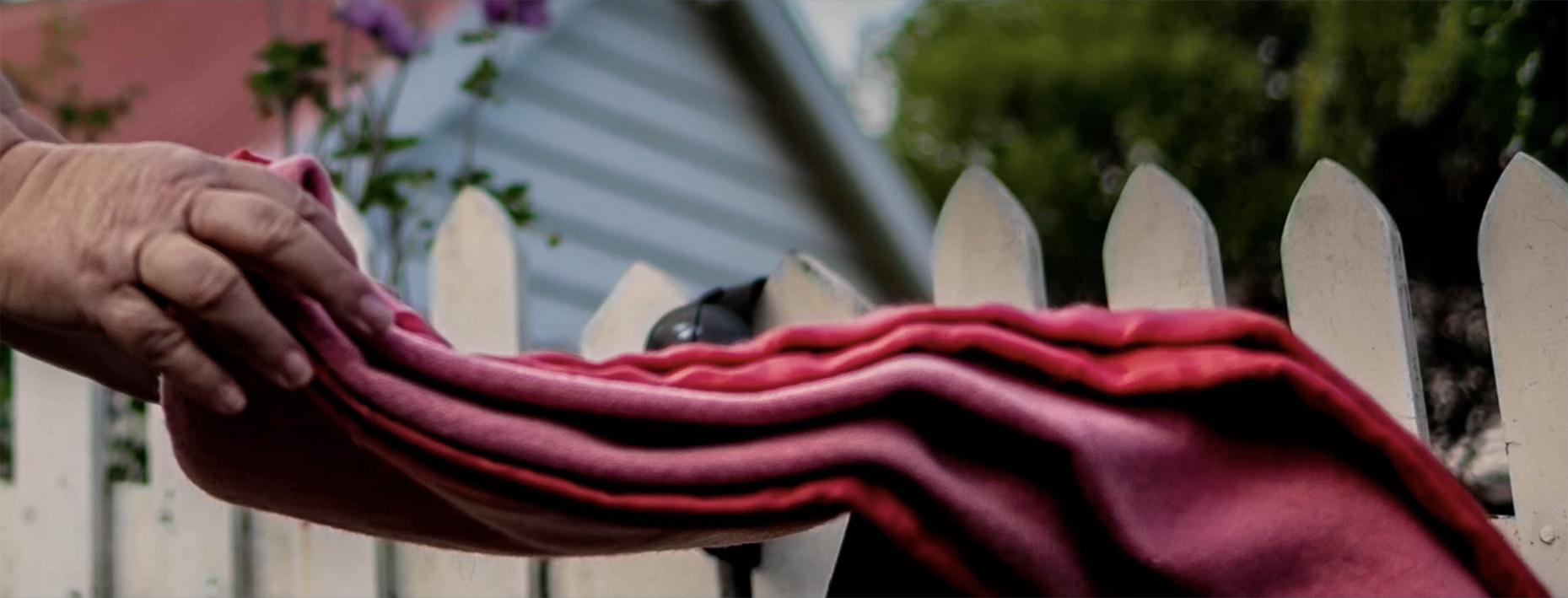
HARK. Monday 22 February 2021, 14 St. Mary’s Street, Thorndon, Te Whanganui-a-Tara, Aotearoa.
Listen on Bandcamp | Subscribe on Apple Podcasts | Subscribe manually via RSS | Download as mp3
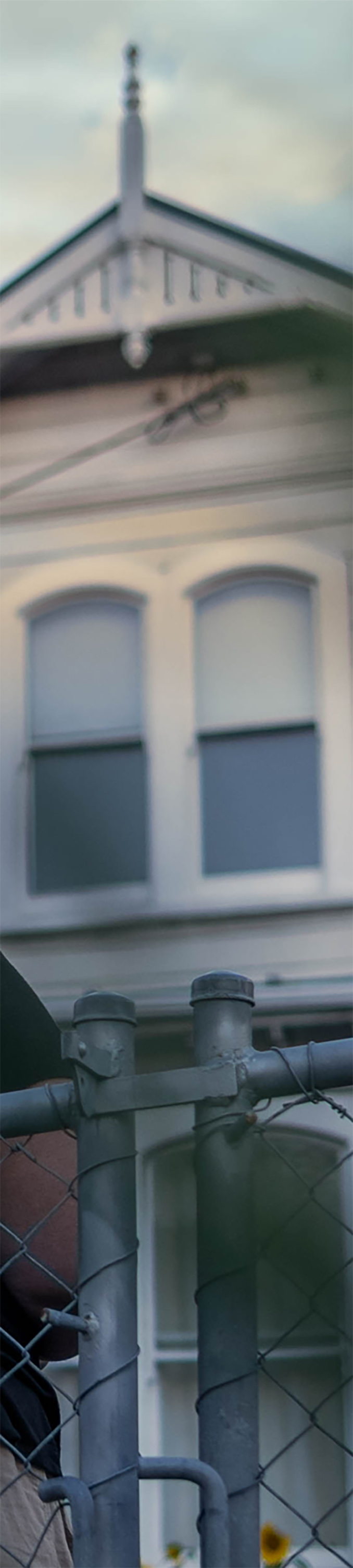
HARK. Tuesday 23 February 2021, 3 Lipman Street, Mount Victoria, Te Whanganui-a-Tara, Aotearoa
Listen on Bandcamp | Subscribe on Apple Podcasts | Subscribe manually via RSS | Download as mp3
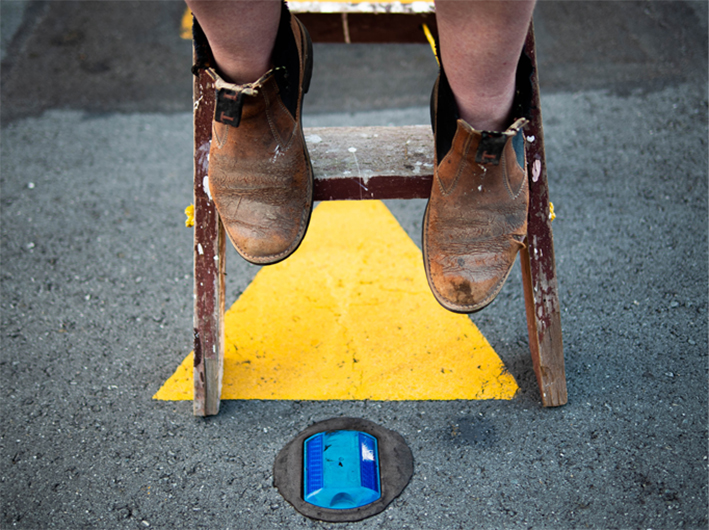
HARK. Wednesday, 24 February 2021. 5 Tutchen Avenue, Mount Victoria, Te Whanganui-a-Tara, Aotearoa.
Listen on Bandcamp | Subscribe on Apple Podcasts | Subscribe manually via RSS | Download as mp3
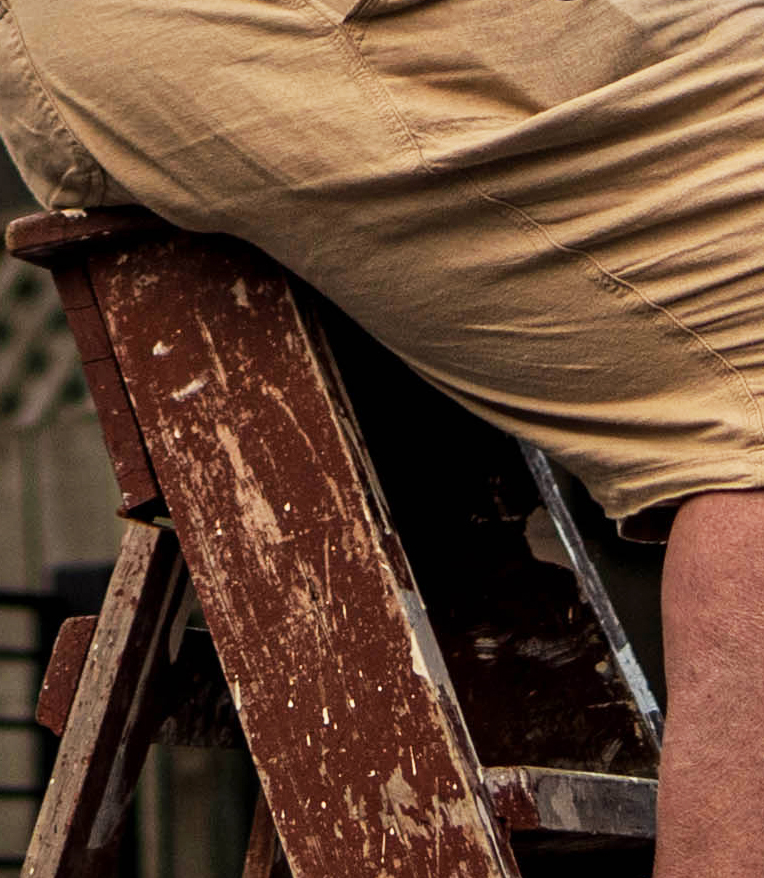
HARK. Thursday 25 February 2021, 56 Motuhara Road, Plimmerton, Aotearoa.
Listen on Bandcamp | Subscribe on Apple Podcasts | Subscribe manually via RSS | Download as mp3

HARK. Friday 26 February 2021, 106 Pirie Street, Mount Victoria, Te Whanganui-a-Tara, Aotearoa.
Listen on Bandcamp | Subscribe on Apple Podcasts | Subscribe manually via RSS | Download as mp3
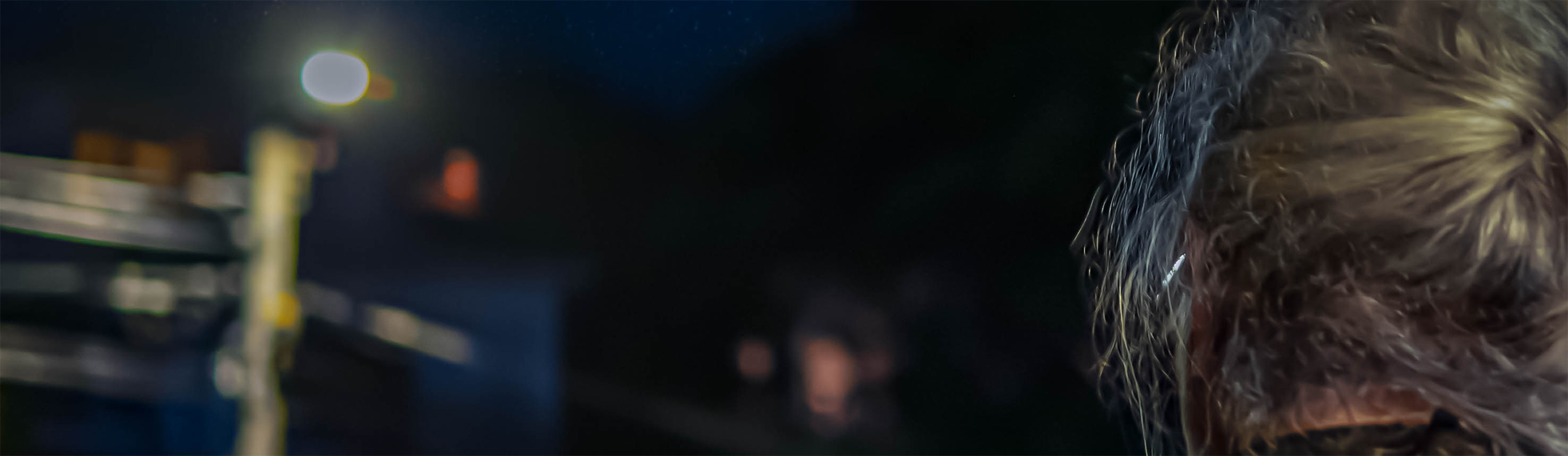
HARK. Saturday 27 February 2021, 9 Konini Road, Hataitai, Te Whanganui-a-Tara, Aotearoa.
Listen on Bandcamp | Subscribe on Apple Podcasts | Subscribe manually via RSS | Download as mp3
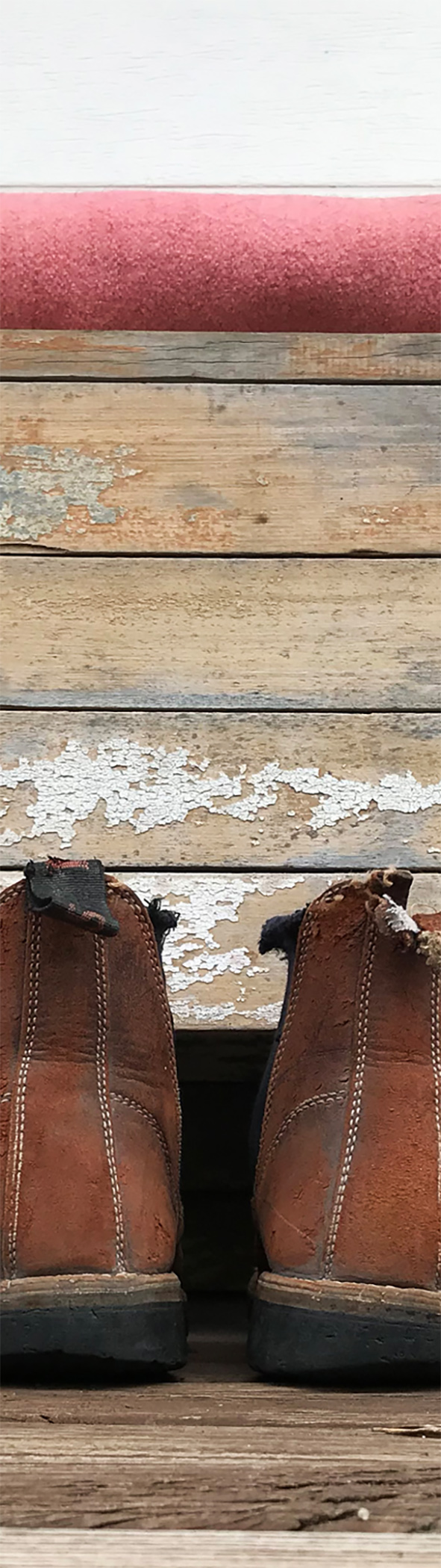
HARK. Sunday 28 February 2021, 10 Kapiti Lane, Ōtaki Beach, Kapiti Coast, Aotearoa.
Listen on Bandcamp | Subscribe on Apple Podcasts | Subscribe manually via RSS | Download as mp3
Alenius, Marianne. 2011. “The Letter - A Genre for Women.” The History of Nordic Women’s Literature, 16 August 2011. https://nordicwomensliterature.net/2011/08/16/the-letter-a-genre-for-women/.
Barton, David, and Nigel Hall, eds. 2000. Letter Writing as a Social Practice. John Benjamins Publishing. https://doi.org/10.1075/swll.9.
Berggren, Rayna. 2022. “Writing the Self, Communally: An Interview with Lauren Fournier” Columbia Journal of Literary Criticism. https://c-j-l-c.org/portfolio/writing-the-self-communally/.
Foucault, Michel. (1982) 1988. Technologies of the Self: A Seminar with Michel Foucault. Edited by Luther H. Martin, Huck Gutman, and Patrick H. Hutton. Tavistock Publications.
Fournier, Lauren. 2021. Autotheory as Feminist Practice in Art, Writing, and Criticism. The MIT Press. https://doi.org/10.7551/mitpress/13573.001.0001.
Fournier, Lauren, and Pamila Matharu. 2021. “MVS Proseminar: ‘Autotheory as Feminist Practice’: Lauren Fournier & Pamila Matharu in Conversation.” Talk at John H. Daniels Faculty of Architecture, Landscape, and Design at the University of Toronto. https://www.youtube.com/watch?v=_I4UTAdyK-g.
Guillén, Claudio. 1994. “On the Edge of Literariness: The Writing of Letters.” Comparative Literature Studies (31) 1: 1–24.
Heddon, Deidre. 2009. “One Square Foot: Thousands of Routes.” In Walking, Writing & Performance: Autobiographical Texts by Deidre Heddon, Carl Lavery and Phil Smith, edited by Roberta Mock. Intellect.
Jones, Alison. 2020. This Pākehā Life: An Unsettled Memoir. Bridget Williams Books. https://doi.org/10.7810/9781988587288.
Labelle, Brandon. 2014. Poetics and Politics of Voice and the Oral Imaginary. Bloomsbury.
Lomax, Yves. 2005. Sounding the Event: Escapades in Dialogue and Matters of Art, Nature and Time. I.B. Tauris.
Luu, Chi. 2019. “The Ladylike Language of Letters.” JSTOR Daily, 10 January 2019. https://daily.jstor.org/the-ladylike-language-of-letters/.
Manning, Erin. 2013. The Minor Gesture. Duke University Press.
Maupin, Amy. 2016. “From the Scroll to the Screen: Why Letters, Then and Now, Matter.” The English Journal 105 (4): 63–68. https://doi.org/10.58680/ej201628396.
Ngata, Tina. n.d. https://tinangata.com/.
Ngawati, Renei. 2018. “He aha te wairua? He aha te mauri?” Ngā Pae o te Māramatanga Student Internship Research Project, Massey University.
Patrick, Martin. 2018. Across the Art/Life Divide: Performance, Subjectivity, and Social Practice in Contemporary Art. Intellect. https://doi.org/10.2307/j.ctv36xvzmr.
Pigounis, Lambros. 2017. “Performing the Politics of Sound: Affective Mobilization and the Objectivity of Sonic Energy on the Human Body.” Critical Stages/ Scènes critiques/ The IATC journal/ Revue de I’AICT 16 (December 2017). https://www.critical-stages.org/16/performing-the-politics-of-sound-affective-mobilization-and-the-objectivity-of-sonic-energy-on-the-human-body/.
Pisano, Leandro. 2020. “The Political Possibility of Sound. Interview with Salomé Voegelin.” Digimag 85, March 2020. https://digicult.it/articles/the-political-possibility-of-sound-interview-with-salome-voegelin/.
Preston, Julieanna. 2021. HARK. What if the City was a Theatre? Performance Arcade, Wellington, Aotearoa New Zealand, 22–28 February 2021. https://www.julieannapreston.space/hark-2021.
Preston, Julieanna. 2023. “DD: holding up the girls.” The Journal of Architecture 28 (6): 925–946. https://doi.org?10.1080/13602365.2023.2264303.
Preston, Julieanna, and Felicia Konrad. 2022. A Chorus of Geo-haptic Tones. Voices in and out of Place: Misplaced, Displaced, Replaced and Interlaced Voices, Newcastle University, UK, 6–7 Sept 2022. https://www.julieannapreston.space/a-chorus-of-geohaptic-tones-2022.
Preston, Julieanna, and Joshua Lewis. 2018. RPM hums. Performance Arcade, Performance Arcade, Wellington, Aotearoa New Zealand, 1–4 March 2018. https://www.julieannapreston.space/rpm-hums-2019/.
Whitman, Slim. 1952. “Indian Love Call.” https://www.youtube.com/watch?v=HBuk1HXcz1k.
Winter, Kathleen, dir. 2019. Land of the Long White Cloud, episode 2: “Inheriting Privilege.” Radio New Zealand. https://www.rnz.co.nz/programmes/land-of-the-long-white-cloud.
Te Aka/ Māori Dictionary. n.d. “wairua.” https://maoridictionary.co.nz/search?&keywords=wairua.